


Views: 7 Author: Site Editor Publish Time: 2026-09-08 Origin: Site


Confirm Design Temperature
Check Pressure-Temperature Ratings for Class Selection
Match Facing Type (RF, FF, RTJ, MFM) to Service Conditions
Select Material (carbon steel, stainless steel, alloy) per Media.
This complete guide covers Class 150 through 2500. Includes five real-world engineering pitfalls. Get your selection right – avoid leaks from day one.
In petrochemical plants, power generation, thermal systems, oil/gas transmission, and fine chemical processes, the ASME B16.5 weld neck flange is the preferred joint for high temperature, high pressure, and cyclic loading.
Most field failures – leaks, weld cracks, frequent trips, long-term creep – trace back to one root cause: incorrect flange selection. The most common error? Using slip-on flanges where WN flanges are required.
The WN advantage: The tapered hub provides a smooth stress transition. After butt welding, stress distributes evenly – no sharp corners, no stress concentration. Result: far better fatigue life, deformation resistance, and crack prevention than slip-on designs.
Lines with thermal cycling
Process lines under sustained cyclic loads
High-temperature, high-pressure main process lines
Flammable, explosive, or highly corrosive media lines
For ambient-temperature, low-pressure, static utility lines (water, drainage, ventilation), slip-on flanges may be used for cost control. Knowing this boundary is your first step in flange selection.
ASME B16.5 is the primary American standard for steel pipe flanges. It defines dimensions, pressure classes, facing types, materials, testing, and manufacturing requirements. It is the mandatory reference for engineers, procurement, and field installation.
Parameter | Specification |
Flange Type | Weld Neck (regular and long hub) |
Facing Types | RF, FF, RTJ |
Size Range | NPS ½” through NPS 24” (DN15–DN1200) |
Applicable Standards | ASME B16.5, ASME B16.47 Series A / B |
Carbon Steel | ASTM A350 LF2, 16Mn |
Low-Temp Steel | ASTM A350 LF2, 16Mn |
Pipeline Steel | ASTM A694 F42 / 46 / 56 / 60 / 65 |
Alloy Steel | ASTM A182 F11 / 12 / F5 / F9 / F91 / F92 |
Stainless Steel | ASTM A182 F304/304L/304H, 316/316L, 310S, 317, 347, 904L |
Duplex SS | ASTM A182 F51, F53, F44 |
Critical boundary – strictly enforce:
ASME B16.5 applies ONLY to NPS 24 and smaller. For NPS 26 and larger, you must switch to ASME B16.47 (Series A or Series B). The two standards have different bolt circles, flange dimensions, and pressure ratings. They are not interchangeable – this is an absolute red line in design and procurement.
Material Grade | Key Performance | Recommended Service | Temperature Range |
A105 Carbon Steel | High strength, cost-effective, readily available | General non-corrosive water, steam, oil | –29°C to 425°C |
A350 LF2 Low-Temp CS | Excellent low-temperature impact resistance | Low-temp oil/gas, refrigeration, arctic/outdoor | –46°C to 425°C |
A182 F304/316L Stainless Steel | Corrosion, acid, alkali, and oxidation resistance | Chemical media, seawater, high-purity, humid environments | –196°C to 870°C |
Alloy Steel (F11, F91, etc.) | High-temperature creep resistance, high-pressure stability | Power generation, hydrotreating, ultra-high temp/pressure | Extreme conditions |
Duplex SS (F51, F53) | High strength + excellent chloride resistance | Offshore, oilfield, FGD systems | Corrosive + high-strength service |
Critical rule: Never bolt dissimilar flange materials directly together. Galvanic corrosion from potential differences will cause face pitting, gasket failure, and leaks within months.
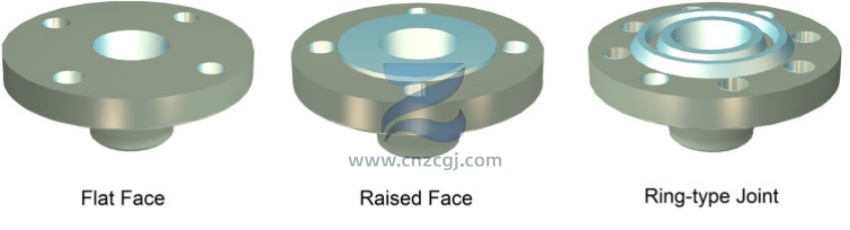
The facing is the sealing interface. Choose wrong – and leaks are guaranteed. ASME B16.5 defines four facings, each with distinct pressure limits and service compatibility.
Facing Type | Key Characteristics | Pressure Range | Best Service Applications | Usage Taboos |
RF (Raised Face) | Easy to machine, wide gasket availability, high tolerance, most common | Class150–600 | General low/medium pressure, water, steam, oil, inert gases at ambient/moderate temps | Not for ultra-high pressure, severe vibration, or extreme thermal cycling |
FF (Flat Face) | Full-face contact, uniform compression, protects fragile components | Class150–300 (low pressure only) | Exclusively for cast iron equipment and valve connections | Never use at high pressure; never mate with an RF face |
RTJ (Ring Type Joint) | Metal-to-metal rigid seal, high resistance to deformation and vibration | Class600–2500 (high/ultra-high) | High-temp, high-pressure, high-vibration, flammable/explosive – oil/gas, hydrotreaters, high-temp steam | Must use a dedicated metal ring gasket – standard gaskets will not seal |
MFM (Male/Female) | Male-female fit centers the gasket, prevents blowout | Class300–900 (medium/high) | Erosive media, moderate vibration, corrosive chemical process lines | Not for extreme high-vibration; mating faces must be ordered as matched pairs |
General low/medium pressure → RF
Cast iron connections → FF (exclusive)
Class600+ / high-temp / hazardous → RTJ (mandatory)
Chemical lines with gasket displacement risk → MFM
Proper selection is not just size and Class. You must consider temperature derating, facing compatibility, material corrosion resistance, and pipe wall thickness matching – all together.
Class is a rating, not a fixed pressure. For A105 carbon steel (the most common material), here are real allowable working pressures:
Class | 38°C Ambient Rating (bar) | 250°C High-Temp Rating (bar) | Selection Guidance |
Class150 | 19.6 | 12.1 | OK for ambient/low-temp lines – upgrade if process exceeds ~200°C |
Class300 | 51.0 | 32.0 | Standard industrial medium-pressure – covers most general processes |
Class600 | 102.0 | 64.0 | High-pressure ambient/moderate-temp – common in chemical high-pressure services |
Field-proven method:
Determine your maximum design temperature → Look up the pressure-temperature table for your chosen material → Select the lowest Class that provides adequate safety margin. This avoids both under-specification (risk) and over-specification (wasted cost).
Use this simple decision tree:
Low/medium pressure, clean services → RF
Cast iron pump/valve connections → FF only
Class600+, high temp, high vibration, lethal service → RTJ (non-negotiable)
Erosive chemical lines, gasket instability → MFM
Correct facing match eliminates the #1 cause of seal failure.
Material is the most critical factor for service life. Choose based on your dominant threat:
No corrosion, general service → A105 carbon steel (cost-effective)
Low-temperature outdoor / refrigeration → A350 LF2 (impact-tested)
Corrosive chemicals / seawater → 304/316L stainless steel
Ultra-high temperature / creep-critical → Alloy steel (F11/F91)
Chloride pitting / offshore → Duplex (F51/F53)
Mandatory rule: Mating flanges must be same material or validated for galvanic compatibility. Never mix, unless a corrosion specialist has approved it.
The WN flange bore must match the pipe’s Schedule wall thickness. Mismatch causes:
Flow turbulence and accelerated erosion
Fouling and localized pressure spikes
Weld cracking and premature failure
Always specify the pipe Schedule when ordering. Ensure the flange bore matches the pipe ID seamlessly.
Based on decades of field experience, these five errors account for most installation problems and in-service leaks:
Pitfall | Consequence | Correct Practice |
❌ Confusing B16.5 with B16.47 | Wrong bolt circle, dimensions, rating – cannot install | NPS ≤ 24 → B16.5; NPS ≥ 26 → B16.47 (specify Series A or B) |
❌ Assuming pressure | Flange fails under high temperature – deformation, leaks, accidents | Always calculate using pressure-temperature ratings for your material |
❌ Mating RF face with FF face | Uneven gasket compression – seal failure guaranteed | Match facings strictly – never mix RF with FF |
❌ Bolting dissimilar materials together | Galvanic corrosion ruins faces, shortens system life | Mating flanges must be same material or approved compatible |
❌ Incomplete ordering specifications | Wrong parts arrive – project delays, rework costs | Use the standard six-parameter template (see below) |
Complete, unambiguous specifications are the only way to avoid ordering errors. Use this template directly:
Example:
Weld Neck Flange (WN Flange), ASME B16.5, 2", SCH10S Class300, RF, ASTM A182 F51
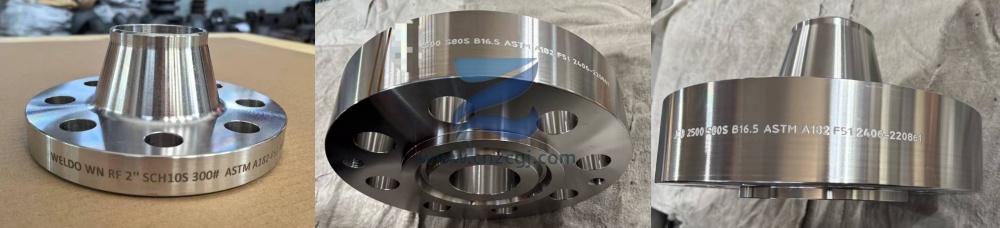
This includes all six mandatory parameters:
Type + Standard + Size + Class + Facing + Material
For custom or severe service, add these extras:
Pipe wall thickness (Schedule number)
Design temperature and pressure
Special NDE requirements (e.g., UT, PMI)
Shanghai Zhucheng Pipe Fittings specializes in American standard flanges. We fully comply with ASME B16.5 production and testing requirements. We supply Class150–2500 WN flanges in carbon steel, low-temp steel, stainless steel, duplex, and alloy steel – covering general, low-temp, high-temp, high-pressure, and severe corrosion services.
In-house quality systems include:
PMI positive material identification (spectro)
UT ultrasonic non-destructive testing
Mechanical properties testing (tensile, hardness, impact)
Every batch includes a full MTR material test report – fully traceable. Our products meet petrochemical, power, oil/gas, and new energy project standards. We also support custom non-standard sizes and special-service flanges.
ASME B16.5 weld neck flange selection is a systematic process – not a simple size lookup. Combine pressure, temperature, media, material, and facing correctly. Avoid the five pitfalls. That ensures long-term system integrity, minimizes maintenance, and eliminates safety risks.
Our team provides one-on-one consultation and fast quoting.
Contact: Jerry Zhao
E-mail:order@zzsteels.com
Related Resource:
[ASME B16.5 WN Flange Dimension Tables] – Full OD, thickness, bolt circle, bolt hole, and weight data.
Absolutely not. They are two completely independent standard systems – different dimensions, bolt circles, facing structures, and pressure ratings. Forced mating will cause bolt misalignment, seal failure, and leakage. Prohibited in all installations.
There is no fixed value. For A105 carbon steel at 38°C, it is 51 bar. At 250°C, it drops to about 32 bar. Always refer to the pressure-temperature table for your specific material and service temperature.
Dedicated metal ring gasket only – soft iron, stainless steel, or alloy per service. The seal is metal-to-metal under compression. Ordinary rubber, spiral-wound, or sheet gaskets cannot provide high-pressure, high-temperature sealing.
