


Views: 14 Author: Site Editor Publish Time: 2026-09-18 Origin: Site


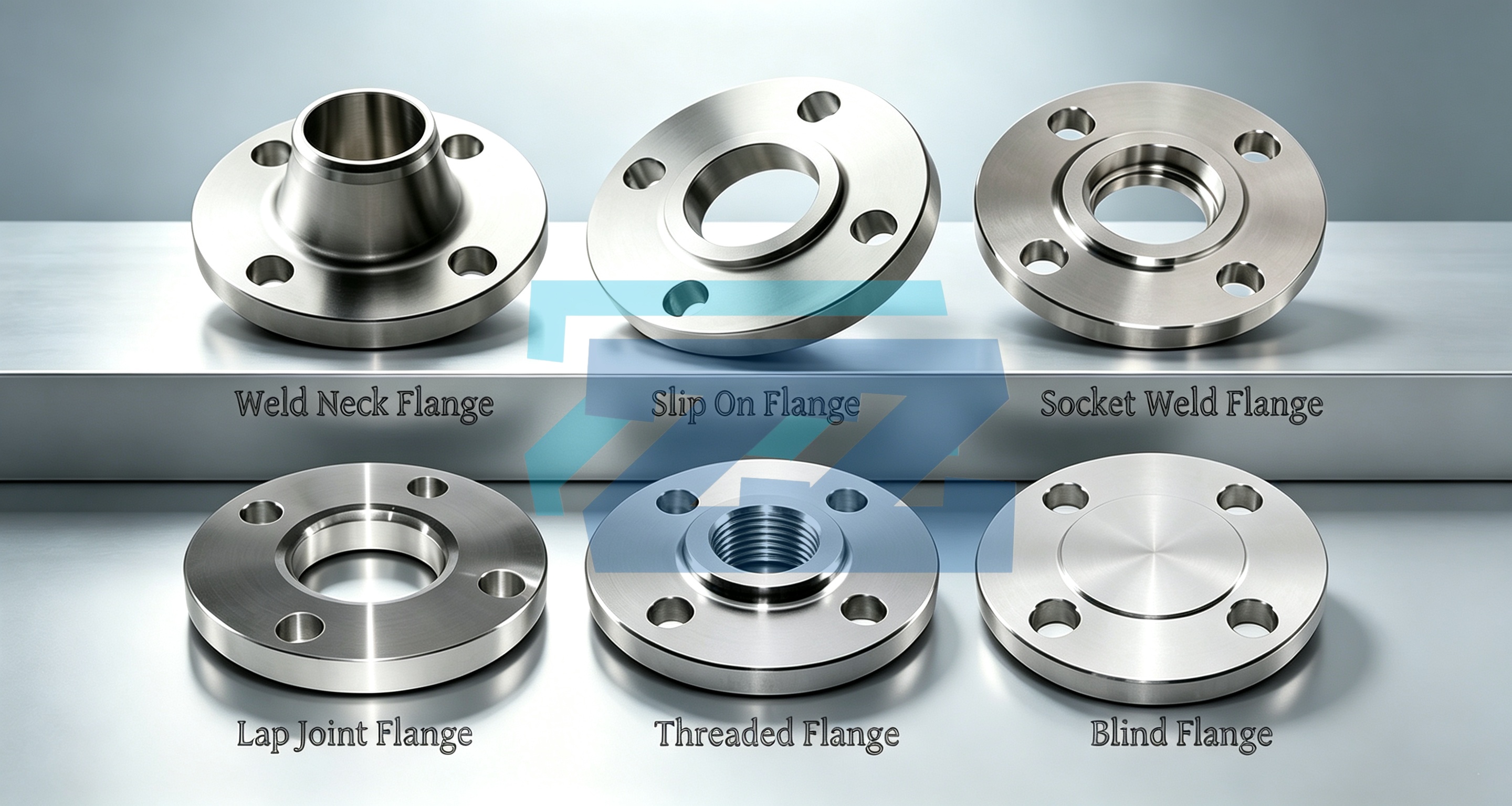
When sourcing ASTM A182duplex stainless steel flanges, do you run into these questions?
What is the real difference between F51, F53, F55 and F60? Choosing the wrong grade can double your cost.
Suppliers all say "corrosion resistant" — but resistant to what? Seawater? Sour oil and gas? High-concentration acid?
The drawing says ASTM A182, but how do you verify pressure class, facing and heat treatment requirements?
Does it need stabilization annealing after welding? What is sigma phase, and how do you avoid it?
This guide gives you one selection table + four material comparisons + heat treatment and inspection points, so you can understand ASTM A182 duplex stainless steel flange selection, parameters and acceptance in 10 minutes — and avoid costly mistakes.
Grade | One-Line Positioning | Corrosion Resistance | Strength | Typical Applications | Cost Index |
F51 | Economical duplex steel, most widely used | Medium | Medium | Seawater desalination pretreatment, chemical storage tanks, municipal wastewater | ★★ |
F53 | High-corrosion-resistance duplex steel, strong against chlorides | High | High | Sour oil and gas, high-concentration pickling, nuclear circulating water | ★★★★ |
F55 | Premium corrosion-resistant duplex steel with W + Cu | Very high | High | Severe corrosion + low-temperature toughness, sulfuric acid service | ★★★★★ |
F60 | High-strength, welding-friendly grade with higher nitrogen | Medium-high | High | Welding without stabilization annealing, general chemical service | ★★★ |
General corrosion, budget-limited → F51
Sour oil and gas, high-concentration chlorides → F53
Severe corrosion + low temperature, sulfuric acid → F55
Heavy welding, lower post-weld cost → F60
ASTM A182 is the authoritative standard issued by ASTM International for forged and rolled alloy and stainless steel pipe fittings for high-temperature and high-pressure service. The current effective version is ASTM A182/A182M-24.
Grade: F51, F53, F55, F60, etc. Each grade has defined chemical composition and mechanical properties.
Mechanical properties: Tensile strength, yield strength, elongation, impact toughness and hardness limits.
Traceability marking: Products must be marked with standard number, material grade, nominal size, pressure class and manufacturer identity.
Product scope: Flanges, forged fittings, valves and parts.
One-line positioning: The most widely used duplex stainless steel grade in industry, costing only 70–80% of F53.
Suitable applications:
Seawater desalination pretreatment pipeline flanges
Chemical storage tank inlet flanges
Municipal wastewater treatment equipment connection flanges
Neutral salt spray and weak acid solution environments
Not suitable for:
High-concentration chlorides, H₂S-containing oil and gas
High-temperature, high-pressure severe corrosion service
Chemical Composition
CHEMICAL | LIMITS | C | Mn | P | S | Si | Ni | Cr | Mo | N |
ASTM A182 F51 | MIN | 4.50 | 21.00 | 2.50 | 0.08 | |||||
MAX | 0.03 | 2.00 | 0.030 | 0.020 | 1.00 | 6.50 | 23.00 | 3.50 | 0.20 |
Mechanical Properties
MATERIAL | T.S (MPA) | Y.S (MPA) | EL % | R/A % |
ASTM A182 F51 | 620 min | 450 min | 25 min | 45 min |
One-line positioning: High-alloy duplex steel with significantly better chloride corrosion resistance than F51.
Suitable applications:
Oil and gas wellhead flanges (sour crude transport)
High-concentration pickling liquor (sulfuric acid ≤20%) pipeline flanges
Nuclear conventional island circulating water pipeline flanges
Resistant to 10% NaCl solution and H₂S-containing oil and gas media
Core advantage: High Mo content effectively inhibits pitting and crevice corrosion.
Chemical Composition
CHEMICAL | LIMITS | C | Mn | P | S | Si | Ni | Cr | Mo | N | Cu |
ASTM A182 F53 | MIN | 6.00 | 24.00 | 3.00 | 0.24 | ||||||
MAX | 0.03 | 1.20 | 0.035 | 0.020 | 0.80 | 8.00 | 26.00 | 5.00 | 0.32 | 0.50 |
Mechanical Properties
MATERIAL | T.S (MPA) | Y.S (MPA) | EL % | R/A % | HARDNESS |
ASTM A182 F53 | 800 min | 550 min | 25 min | 15 min | 310 max |
One-line positioning: The premium grade among ASTM A182 duplex stainless steel flanges, with W + Cu for severe corrosion and low-temperature toughness.
Suitable applications:
Severe corrosion + low-temperature service
Sulfuric acid environments (Cu improves sulfuric acid resistance)
Applications requiring grain refinement and enhanced low-temperature toughness
Core advantages:
W addition (0.5–1.0%) improves pitting and crevice corrosion resistance
W refines grain structure and enhances low-temperature toughness
Cu addition improves sulfuric acid corrosion resistance
Chemical Composition
CHEMICAL | LIMITS | C | Mn | P | S | Si | Ni | Cr | Mo | N | Cu | W |
ASTM A182 F55 | MIN | 6.00 | 24.00 | 3.00 | 0.20 | 0.50 | 0.50 | |||||
MAX | 0.03 | 1.00 | 0.030 | 0.010 | 1.00 | 8.00 | 26.00 | 4.00 | 0.30 | 1.00 | 1.00 |
Mechanical Properties
MATERIAL | T.S (MPA) | Y.S (MPA) | EL % | R/A % |
ASTM A182 F55 | 750-895 | 550min | 25min | 45min |
One-line positioning: Higher nitrogen than F51, excellent weldability, no stabilization annealing required after welding.
Suitable applications:
Piping systems with extensive welding
General chemical media
Applications where reduced post-processing cost is desired
Core advantages:
N content 0.14–0.20%, higher than F51's 0.08–0.20%
N as an interstitial strengthening element raises strength and corrosion resistance without reducing toughness
After welding, no stabilization annealing is needed to maintain phase balance, reducing downstream processing cost
Chemical Composition
CHEMICAL | LIMITS | C | Mn | P | S | Si | Ni | Cr | Mo | N |
ASTM A182 F60 | MIN | 4.50 | 22.00 | 3.00 | 0.14 | |||||
MAX | 0.03 | 2.00 | 0.030 | 0.020 | 1.00 | 6.50 | 23.00 | 3.50 | 0.20 |
Mechanical Properties
MATERIAL | T.S (MPA) | Y.S (MPA) | EL % | R/A % |
ASTM A182 F60 | 655min | 450min | 25min | 45min |
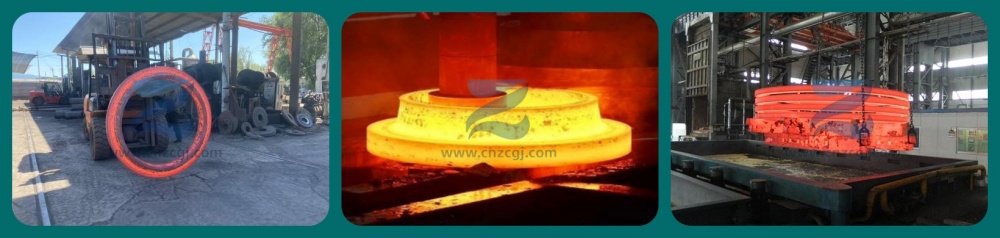
The core microstructure of duplex stainless steel flanges is a ferrite + austenite two-phase structure, typically controlled at 40–60%. The key to heat treatment is solution annealing followed by immediate water quenching to avoid sigma phase precipitation.
Purpose: Fully dissolve alloying elements (Cr, Mo, N, etc.) into the matrix, form a uniform duplex structure, relieve forging residual stress, and inhibit brittle phases (sigma, chi).
Sigma phase risk: Sigma is a hard, brittle intermetallic compound (mainly Cr and Mo). If held too long in the 600–900°C range, it sharply reduces toughness (impact energy may drop below 10 J) and worsens corrosion resistance.
Grade | Recommended Temperature |
F51 / F60 | 1020–1080°C |
F53 / F55 | 1050–1100°C (higher Mo and Cr require higher temperature for full dissolution) |
Heating rate: 50–100°C/h to avoid cracking from thermal gradients; uniform heating above 800°C.
Formula: Holding time = 1 h + (t − 25 mm) × 0.2 h / 25 mm
Example: For a 50 mm wall thickness flange, holding time = 1 h + (50 − 25) × 0.2 h / 25 mm = 1.2 h
Minimum holding time not less than 30 min (for wall thickness ≤10 mm)
Ensure uniform internal and external temperature (monitor with thermocouples)
Water quenching is mandatory, cooling rate ≥50°C/min (from solution temperature to 400°C)
Immediately immerse in flowing water after furnace discharge (water temperature ≤30°C, water volume ≥5× forging volume), keep turning the forging to avoid uneven cooling
For large flanges with wall thickness ≥100 mm, use "water mist + spray water" combined cooling
Air cooling or slow cooling is prohibited (causes sigma phase precipitation)
After solution annealing, inspect:
Metallography: 40–60% phase ratio, no obvious sigma phase
Hardness: Meet grade limits, e.g. F53 ≤310 HB
Tensile properties: Yield and tensile strength meet standard requirements
Grade | Heat Treat Type | Austenitizing/Solutioning Temperature, Minimum or Range, °F[°C] | Cooling Media | Cooling Media Below °F[°C] |
F51 | solution treat and quench | 1870 [1020] | liquid | 500 [260] |
F53 | solution treat and quench | 1880 [1025] | liquid | 500 [260] |
F55 | solution treat and quench | 2010-2085 [1100-1140] | liquid | 500 [260] |
F60 | solution treat and quench | 1870 [1020] | liquid | 500 [260] |
The table below lists pressure-temperature ratings for these materials. Values are allowable working pressures (psi) at temperature (°F). Linear interpolation is permitted for intermediate temperatures.
Temp. | Working Pressure by Classes, psi | ||||||
150# | 300# | 400# | 600# | 900# | 1500# | 2500# | |
-20~100 | 290 | 750 | 1000 | 1500 | 2250 | 3750 | 6250 |
200 | 260 | 745 | 990 | 1490 | 2230 | 3720 | 6200 |
300 | 230 | 665 | 890 | 1335 | 2000 | 3335 | 5560 |
400 | 200 | 615 | 820 | 1230 | 1845 | 3070 | 5120 |
500 | 170 | 580 | 775 | 1160 | 1740 | 2905 | 4840 |
600 | 140 | 555 | 740 | 1115 | 1670 | 2785 | 4640 |
Important: Because duplex stainless steels may embrittle after service at moderately elevated temperatures, they are not permitted above 600°F [315°C].
Comparison | ASTM A182 | ASTM A312 |
Product form | Flanges, forged elbows, tees, valve bodies | Seamless / welded steel pipe |
Process | Forging (open-die + closed-die) | Hot rolling / cold drawing / welding |
Purpose | Pipe connection and system control | Fluid / gas conveyance |
Size designation | Nominal diameter (DN) + pressure class (PN) | Outer diameter (OD) + wall thickness (SCH) |
Dimensional standard | ASME B16.5 / B16.47 | ASTM A999 |
Product nature | Non-continuous component | Continuous component |
In one sentence: A182 makes connections, A312 makes pipe. They work together and are not interchangeable.
Industry | Recommended Grade | Reason |
Petrochemical | Sour service: F53/F55; general chemical: F51/F60 | Sour service needs high Mo and N |
Seawater desalination | Pretreatment: F51; high-pressure RO: F53/F55 | Chloride concentration drives grade |
Nuclear power | Conventional island circulating water: F53; safety class requires extra certification | High corrosion resistance + high-temperature performance |
Food and pharmaceutical | F51/F60, hygienic surface required | Economical + easy to process |
New energy | F53/F55 preferred based on medium and temperature | Severe corrosion + long service life |
A: F53 has higher Cr, Mo and N, giving significantly better chloride corrosion resistance, but costs about 1.3–1.4× F51. Choose F51 for general corrosion, F53 for sour oil and gas or high-chloride service.
A: Not permitted above 600°F [315°C], because duplex stainless steels may embrittle after service at moderately elevated temperatures.
A: F60 does not require stabilization annealing after welding to maintain phase balance. Other grades should be evaluated based on service conditions.
A: Sigma is a hard, brittle intermetallic compound that precipitates if held too long at 600–900°C, sharply reducing toughness. Avoid it by solution annealing followed by immediate water quenching at ≥50°C/min.
A: A182 is the forged flange/fitting standard; A312 is the steel pipe standard. They differ in product form, process and application, and are used together.
Strict quality control: Full-process control from raw material to delivery. Every batch of duplex stainless steel flanges undergoes multiple inspections to meet international standards.
Customization: Special sizes, pressure classes and materials for stainless steel forged flanges.
Fast delivery: Large stock of common stainless steel forged flange sizes ensures on-time delivery for urgent orders.
Professional after-sales: Experienced team provides technical support and solutions.
