


Views: 4 Author: Site Editor Publish Time: 2026-06-17 Origin: Site


These are fittings made from ferritic, duplex (ferritic/austenitic), and martensitic stainless steels under ASTM A815/A815M. They use butt-weld connections. Common types include butt-weld elbows, tees, and reducers. They are mainly used in high-pressure or corrosive environments.
ASTM A815/A815M is a standard for wrought ferritic, ferritic/austenitic (duplex), and martensitic stainless steel pipe fittings. It covers seamless and welded butt-weld fittings. These fittings are divided into two classes: WP (high pressure) and CR (low pressure). WP class fittings follow ASTM A960 high-pressure requirements. CR class fittings follow MSS SP-43 thin-wall standards and are for low-pressure use.
Class | Manufacturing and Testing Requirements |
WP-S | Seamless, no weld seam |
WP-W | Has weld seam, with random radiographic testing (RT) |
WP-WX | Has weld seam, with 100% radiographic testing (RT) on all welds |
WP-WU | Has weld seam, with 100% ultrasonic testing (UT) on all welds |
ASTM A815 is the dedicated standard for duplex and ferritic/martensitic stainless steel fittings. Its structure is very similar to ASTM A403 (the standard for austenitic stainless steel fittings). Both use WP/CR classes and both reference A960. When selecting, match the material grade to the correct standard – use A403 for austenitic, and A815 for duplex/ferritic/martensitic. For projects with strict weld quality requirements, clearly specify WP-WX or WP-WU sub-types in procurement.
Parameter | Details |
Material Standard | ASTM A815 / A815M |
Manufacturing Std | ASME/ANSI B16.9, ASTM A960, MSS-SP-43 |
Size Range | NPS 1/8" to 48" |
Types | Butt-weld elbows, tees, crosses, reducers, caps, lap-joint stub ends |
Wall Thickness | Sch 5s, Sch 10s, Sch 40s, Sch 80s, Sch 160s, Sch XXS |
ASTM A815 stainless steel butt-weld fittings cover nominal sizes from DN15 (1/2 inch) to DN1200 (48 inches). This meets various piping system size needs.
They follow ASME B16.9 design standards. Common schedules include SCH 10S, SCH 40S, and SCH 80S for stainless steel. Heavy-wall schedules for high-pressure use are also available. This ensures pressure capacity matches the piping system.
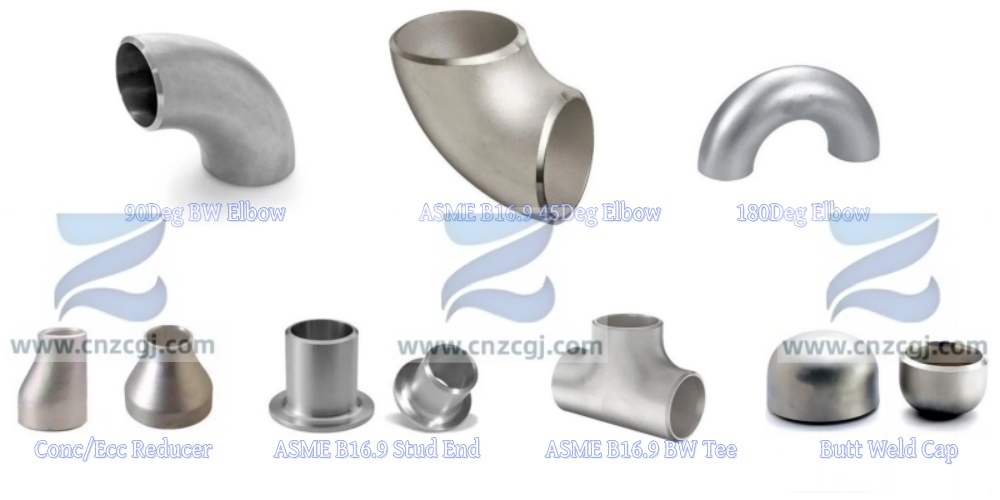
ASME B16.9 stainless steel butt-weld fittings are grouped by shape and function. Types include elbows, tees, crosses, reducers, and caps. All are connected by butt welding to ensure joint strength and sealing.

These are stainless steel fittings with beveled ends for welding. They change pipe direction. Common angles are 45°, 90°, and 180°. They come in long radius (R = 1.5D) and short radius (R = 1.0D). Materials are often 304 or 316L stainless steel and meet ASTM A403. They offer strong corrosion resistance. Welded joints give good sealing and high pressure resistance. They suit high-pressure, high-temperature, and corrosive media. Common in chemical, petroleum, and food processing. Production requires strict size and bevel quality control. Some need non-destructive testing to ensure proper fit and long-term service.

These are austenitic stainless steel butt-weld fittings made under ASTM A815. They are used for branching or merging flow. Types include equal tees and reducing tees. Materials like 304 and 316L give good corrosion resistance. Both ends and the branch have welding bevels. They need welding for connection. Sealing and pressure resistance are excellent. They fit medium- to high-pressure and corrosive conditions. ASTM A815 sets clear rules for chemical composition, mechanical properties, size tolerances, and surface quality. Some require non-destructive testing. They are widely used in chemical, petroleum, and food processing piping. They are made by forging or pressing, with smooth transitions between main pipe and branch to reduce flow impact and avoid local pressure build-up.

These are transition fittings that connect pipes of different diameters. They include concentric reducers (CONC) and eccentric reducers (ECC). Concentric reducers suit vertical pipes or where flow stability is important. Eccentric reducers prevent air pockets at the top or liquid pooling at the bottom. Materials are often 304 or 316L stainless steel. They meet ASME B16.9 or GB/T 12459. They have strong corrosion resistance. Connection is by welding, with beveled ends for good sealing. They work from medium to high pressure. They reduce flow resistance and turbulence during diameter changes. Size accuracy and wall thickness tolerances must meet standards. Surfaces must be smooth and defect-free. They are widely used in chemical, food, and water treatment piping to achieve smooth transitions between different pipe sizes.

These fittings close pipe ends. They prevent fluid leakage or outside contamination. Shapes include elliptical, round, and conical caps. Standards set requirements for wall thickness, size tolerances, and surface quality. Some need non-destructive testing to avoid cracks or dents. This ensures safe and stable pipe end closure.
ASTM A815/A815M covers three stainless steel types: ferritic, ferritic/austenitic (duplex), and martensitic. These are classified by internal metallurgical structure. All have chromium as the main alloy element, but they differ in performance, use, and identification.
Property | Ferritic | Martensitic | Duplex |
Internal Structure | Ferrite | Martensite | Ferrite + Austenite (~50% each) |
Magnetic | Yes | Yes | Yes |
Heat Treatment | Cannot harden | Can harden (quench + temper) | Cannot harden |
Strength/Hardness | Medium | High / very high | Very high (yield strength ~2x 304) |
Toughness | Poor (low-temperature brittle) | Poor (brittle) | Good |
Corrosion Resistance | Good (excellent stress corrosion resistance) | Fair (poor) | Excellent (pitting and stress corrosion resistant) |
Weldability | Poor (easily brittle) | Poor (crack-prone) | Good (better than the first two) |
Typical Uses | Car exhaust, dishwasher liners | Knives, bearings, surgical tools | Chemical plant pipes, desalination equipment |
Ferritic steels are in the 400 series. Chromium content is 10.5%–27%. They contain almost no nickel and are magnetic.
UNS | Typical Grade | Chromium % | Features and Uses |
S42900 | WP429 | 14–16 | Car exhaust systems, most economical |
S43000 | WP430 | 16–18 | Widely used – washing machine drums, kitchen equipment, decoration. Can replace 304 |
S44627 | WP27 | 25–27 | High chromium, excellent stress corrosion resistance, heat exchanger tubes |
S44660 | WP446 | 23–27 | High chromium with molybdenum, excellent pitting resistance |
Key Points: Cost-effective, good chloride stress corrosion resistance, but weld ability is poor.
Martensitic steels are in the 400 series. Chromium is 11.5%–18%. Carbon is higher (0.1%–1.2%). They are magnetic and can be hardened by heat treatment.
AISI Grade | UNS | Carbon % | Features |
WP410 | S41000 | 0.15 | High strength, magnetic |
WPS41008 | S41008 | 0.08 | Better weld ability than 410 |
WPS41500 | S41500 | 0.05 | High strength, good toughness, excellent weldability |
Key Points: High hardness and wear resistance, but corrosion resistance is relatively poor.
Duplex steels are about 50% ferrite + 50% austenite. They are magnetic. Yield strength is roughly twice that of austenitic stainless steel. They are divided into four grades by PREN (pitting resistance equivalent number).
UNS | Grade | Ni % | Cr % | Features and Uses |
S31803 | WPS31803 | 4.5–6.5 | 21.0–23.0 | Most common duplex steel. Petrochemical, marine engineering |
S32205 | WPS32205 | 4.6–6.5 | 22.0–23.0 | Improved version of S31803, more stable performance |
S32550 | WPS32550 | 4.5–6.5 | 24.0–27.0 | Contains copper, seawater corrosion resistant |
S32750 | WPS32750 | 6.0–8.0 | 24.0–26.0 | Most common super duplex steel. Harsh media |
S32760 | WPS32760 | 6.0–8.0 | 24.0–26.0 | Contains tungsten and copper, excellent seawater corrosion resistance |
Key Points: High strength, excellent chloride corrosion resistance, balanced overall performance.
Both are ASTM standards for wrought stainless steel pipe fittings. They are very similar in product types, class levels, and manufacturing requirements. The core difference is the material type covered.
Aspect | ASTM A815 | ASTM A403 |
Materials Covered | Ferritic, duplex, and martensitic stainless steels | Austenitic stainless steels (e.g., 304/316 series) |
Typical Grades | S31803, S32205 (duplex 2205), S32750 (super duplex 2507), S32304 (2304) | WP304, WP304L, WP316, WP316L, etc. |
Key Performance | High strength. Duplex yield strength (≥450 MPa) is about 2.5–3x that of austenitic 316L (≥170 MPa). Better chloride stress corrosion resistance. | Good all-round performance. Excellent toughness, corrosion resistance, and weld ability. Most common stainless steel. |
Despite different materials, the two standards share a similar technical framework:
Same product forms: both cover butt-weld, socket-weld, and threaded fittings (not cast fittings).
Same class system: both have WP (high pressure) and CR (low pressure / thin-wall per MSS SP-43).
Same manufacturing sub-types: both divide WP class into WP-S (seamless), WP-W (welded, random RT), WP-WX (100% RT), etc.
Same general requirements: both follow ASTM A960 for manufacturing, inspection, and marking.
Different mechanical property requirements: due to material differences, the required mechanical properties differ significantly.
ASTM A403: Used for ordinary piping systems with moderate corrosion requirements. Examples: general chemical, food, pharmaceutical, building plumbing.
ASTM A815: Designed for demanding environments needing high strength and chloride corrosion resistance. Examples: marine engineering, offshore oil platforms, desalination, high-chloride chemical media.
Choose ASTM A403 for austenitic stainless steel fittings. Choose ASTM A815 for duplex and higher-strength materials.
