


Views: 7 Author: Site Editor Publish Time: 2026-08-10 Origin: Site


Duplex stainless steel butt-weld fittings are widely specified for marine engineering, desalination, chemical FGD, oil & gas, and shipboard piping—where corrosion is aggressive and pressures run high. They solve performance issues that 316 stainless steel has long struggled with.
316 stainless steel (austenitic) is common, but in seawater, high-chloride, or acid/alkaline alternating conditions, its weaknesses are clear: pitting, crevice corrosion, and stress corrosion cracking (SCC) often emerge within 1–2 years, leading to frequent repairs and rising maintenance costs.
Duplex stainless steel offers a fundamentally different response. Its austenite-ferrite dual-phase structure combines the toughness and weldability of austenitic grades with the strength and SCC resistance of ferritic steels—setting it apart from conventional stainless materials.
For butt-weld fittings, the real-world advantages are straightforward:
Corrosion resistance: PRE values significantly exceed 316, with superior tolerance to seawater, chlorides, and acidic media.
Mechanical strength: Yield strength is roughly double that of 316, with better tensile and fatigue performance under high-pressure surges and cyclic loading.
Service life: Extended operating life and fewer maintenance shutdowns. Higher upfront material cost is offset by lower total lifecycle cost.
Bottom line: When the environment is corrosive, the medium is aggressive, and pressures are high, duplex stainless steel butt-weld fittings aren't just an alternative—they're the smarter choice.
Parameter | 316 Stainless Steel | Duplex Stainless Steel (S31803/S32205) |
PREN (Pitting Resistance Equivalent) | 24–29 | 32–38 |
Yield Strength (MPa) | ~205 | ≥450 |
Tensile Strength (MPa) | ~515 | ≥620 |
Corrosion Rate in Seawater | High | Significantly lower (3–5x better) |
SCC Resistance | Poor | Excellent |
Typical Wall Thickness for Same Pressure | Thicker | Thinner (weight & cost savings) |
Element | SS316 | Duplex S31803/S32205 |
Chromium | 16.0–18.0 | 21.0–23.0 |
Nickel | 10.0–14.0 | 4.5–6.5 |
Molybdenum | 2.0–3.0 | 2.5–3.5 |
Nitrogen | ≤0.10 | 0.14–0.20 |
Key Takeaway: Duplex stainless steel butt-weld fittings deliver superior corrosion resistance, higher mechanical strength, and better long-term economy—making them the preferred upgrade for high-pressure, heavy-duty welded piping systems.
We manufacture duplex stainless steel butt-weld fittings to ASTM A815/SA815, with UNS S31803 and UNS S32205 as our primary grades—the two most widely specified duplex materials in the industry.
Parameter | UNS S31803 (Standard Duplex) | UNS S32750 (Super Duplex) |
Common Name | 2205 Duplex | SAF™ 2507 |
PREN | 32–36 | ≥42 |
Yield Strength (MPa) | ≥450 | ≥550 |
Tensile Strength (MPa) | ≥620 | ≥800 |
Key Composition | Cr 21-23%, Ni 4.5-6.5%, Mo 2.5-3.5%, N 0.08-0.20% | Cr 24-26%, Ni 6-8%, Mo 3-5%, N 0.24-0.32% |
Corrosion Resistance | Excellent against seawater, chlorides, acids | Superior in extreme chloride/high-temp conditions |
Typical Applications | Offshore platforms, seawater cooling, chemical/petrochemical, FGD, ballast lines | Deepwater marine, FPSO topsides, desalination, aggressive chemical processing |
Cost Position | Cost-effective upgrade over 316 | Premium grade for extreme service |
Standard: ASTM A815 / ASME SA815
Dimensional standards: ANSI/ASME B16.9, B16.28, MSS-SP-43
Size range: NPS 1/2" to 24" (up to 48" available)
Wall thickness: Sch 10S, Sch 40S through Sch XXS
Ends: Butt-weld (BW)
Finish: Solution annealed + pickled/passivated
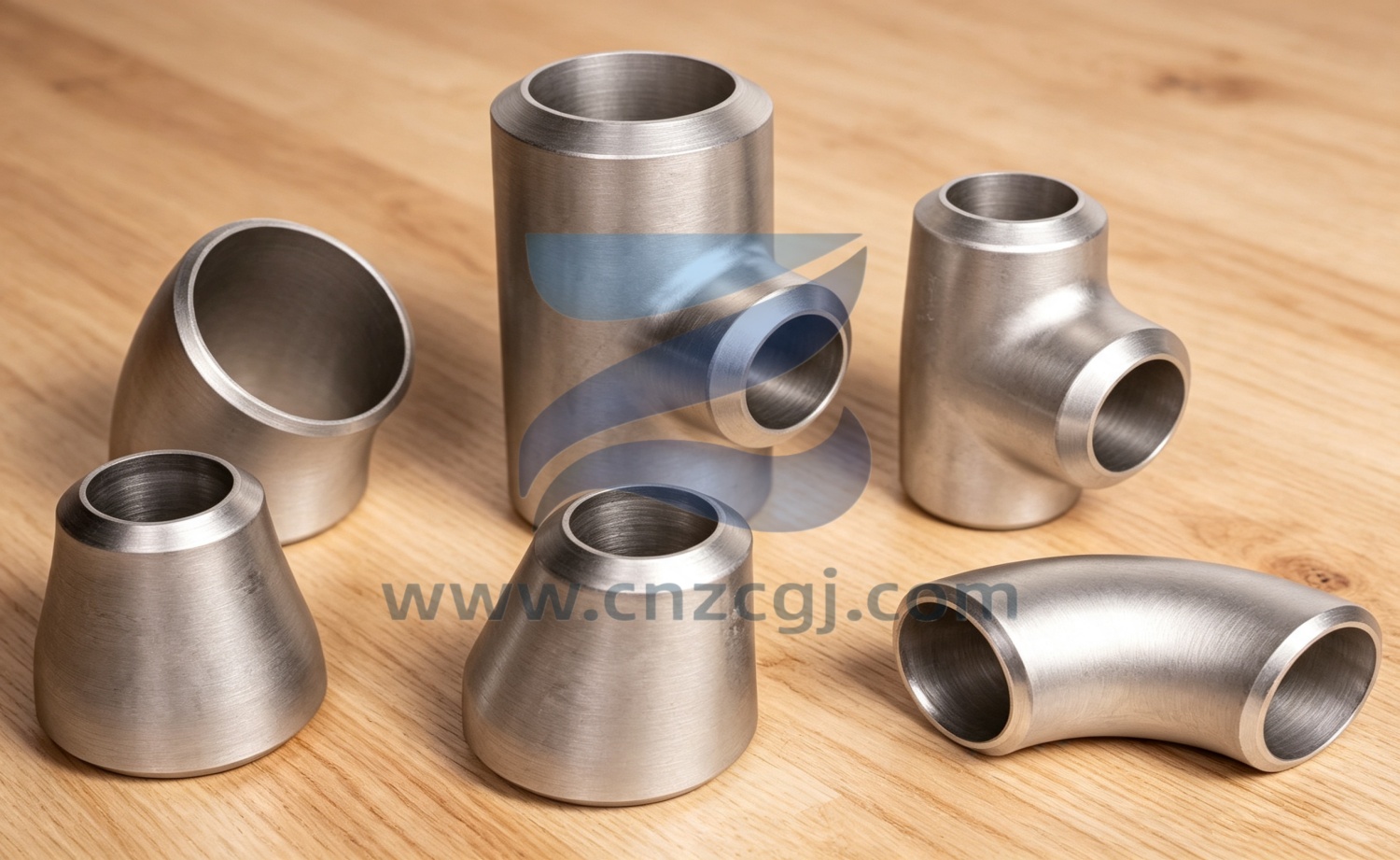
We offer a complete line of duplex stainless steel butt-weld fittings, available as standard stock items or custom-fabricated to project requirements.
Product Type | Common Sizes | Custom Options |
90° Elbow / 45° Elbow | NPS 1/2"–24" | Up to 48", special radii |
Concentric / Eccentric Reducer | NPS 1/2"–24" | Up to 48", custom transitions |
Equal Tee / Reducing Tee | NPS 1/2"–24" | Up to 48", custom branch sizes |
3D Bend / 5D Bend | NPS 1/2"–24" | Custom radii and angles |
Long / Short Stub End | NPS 1/2"–24" | Custom lengths |
Cross | NPS 1/2"–24" | Up to 48" |
Cap | NPS 1/2"–24" | Up to 48" |
Standards compliance: ANSI/ASME B16.9, B16.28, MSS-SP-43, EN10253-4
Construction: Seamless and welded options available
Custom fabrication: Supported for non-standard diameters, wall thicknesses, and special geometries per customer drawings
When to choose duplex over 316:
Application Condition | Recommended Material |
Atmospheric / dry / mild corrosion | 316 Stainless (adequate) |
Seawater immersion or coastal salt spray | Duplex S31803/S32205 |
High chloride / acidic media | Duplex S31803/S32205 |
Extreme chloride + high temperature / high pressure | Super Duplex S32750 |
High-pressure / cyclic loading services | Duplex (all grades) |
Long design life with low maintenance requirement | Duplex (all grades) |
Quality Assurance – All products undergo:
Metallographic examination (micro structure verification)
Corrosion performance testing
Non-destructive testing (NDT) and pressure testing
Precision dimensional inspection
Result: Fittings are free from voids, cracks, or porosity, with consistent chemistry, stable mechanical properties, and full traceability.
We provide complete duplex stainless steel piping solutions—high quality, good fit, and competitive cost. Export orders and bulk project procurement are welcome.
For product data sheets, weight tables, material test reports, samples, or custom quotes, please contact us.
Question | Answer |
Q1: Duplex or 316 for seawater? | Duplex. PRE 32-38 vs. 24-29 for 316—3–5x better chloride resistance. |
Q2: Can duplex replace 316? | Yes—performance upgrade across corrosion, strength, and service life. |
Q3: Standards & sizes? | ASTM A815/SA815; ANSI/ASME B16.9/B16.28/MSS-SP-43; NPS 1/2"–48"; Sch 10S–XXS. |
Q4: Key industries? | Marine, desalination, oil & gas, chemical FGD, shipbuilding, power, wastewater. |
Q5: Custom fabrication? | Yes—all product types, non-standard sizes, per drawing. |
Q6: Mechanical advantage? | Yield ≥480 MPa (~2x 316), high toughness, fatigue and SCC resistance. |
