


Views: 10 Author: Site Editor Publish Time: 2026-09-04 Origin: Site


In petrochemical, deep-sea marine, high-pressure oil & gas transmission, FPSO, and desulfurization projects, duplex stainless steelforged pipe fittings are critical pressure-containing components. They enable directional changes, size reductions, flow branching, sealing, and equipment connections.
Material quality and production control directly determine sealing stability, corrosion resistance, and service life of the entire piping system.
Compared to standard austenitic stainless steels, duplex stainless steel forged fittings offer superior mechanical properties and corrosion resistance. They perform reliably under high-pressure cyclic loading, low-temperature deep-sea conditions, and acidic corrosive environments.
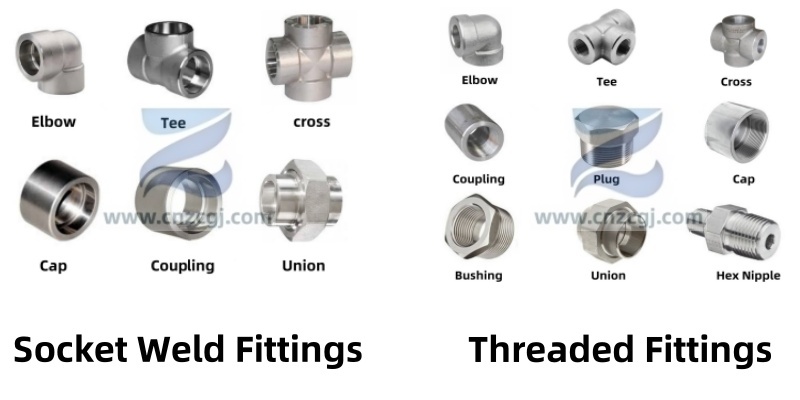
ASTM A182 – Standard Specification for Forged or Rolled Alloy and Stainless Steel Pipe Flanges, Forged Fittings, Valves, and Parts for High-Temperature Service – is the internationally recognized standard for duplex forged fittings.
Duplex grades are designated with the prefix "F". Common grades: F51, F60, and F53 – each with distinct UNS numbers, chemical compositions, and corrosion resistance levels.
F60 is an optimized version of F51 and now the preferred grade for high-end projects. F53 is super duplex – designed for extreme corrosive and high-pressure conditions.
ASTM A182 F51 (UNS S31803): Classic 22% chromium duplex stainless steel. First-generation standardized duplex forging material. Chromium: 21.0%–23.0%, with Mo and N additions to form a stable austenite-ferrite structure. Cost-effective. Suitable for moderate chloride service. Widely used in general industrial pressure fittings.
ASTM A182 F60 (UNS S32205): Upgraded, tighter version of F51 – 2205 duplex. Higher minimum limits for Cr, Mo, and N – the key corrosion-resistant elements. Eliminates the performance variability seen in F51 when compositions drift to lower limits. Dual-certified as S31803/S32205. Can fully replace F51 – but not vice versa. Preferred material for marine and chemical projects.
ASTM A182 F53 (UNS S32750 / 2507): Premium super duplex stainless steel. Significantly higher Cr, Mo, and N content. Denser microstructure. Superior resistance to pitting, crevice corrosion, and SCC. Designed for extreme conditions: full seawater immersion, high-chloride high-temperature, and sour oil/gas environments.
The industry uses PREN (Pitting Resistance Equivalent Number) to quantify chloride corrosion resistance of duplex steels. Formula: PREN = %Cr + 3.3×%Mo + 16×%N. Higher values indicate better localized corrosion resistance.
ASTM Grade | UNS | Cr (%) | Mo (%) | N (%) | PREN (Typical Range) | Yield Strength (MPa) | Tensile Strength (MPa) | Max Service Temp |
F51 | S31803 | 21.0–23.0 | 2.5–3.5 | 0.08–0.20 | 31.0–36.0 | ≥450 | ≥620 | ≤280°C |
F60 | S32205 | 22.0–23.0 | 3.0–3.5 | 0.14–0.20 | ≥35.0 | ≥450 | ≥655 | ≤280°C |
F53 | S32750 | 24.0–26.0 | 3.0–5.0 | 0.24–0.32 | ≥42.0 | ≥550 | ≥750 | ≤300°C |
Compared to 316L austenitic stainless steel, duplex grades offer approximately 2× higher yield strength. This allows thinner wall thickness designs under the same pressure – reducing equipment weight and overall project costs. Duplex also provides good toughness and fatigue resistance – ideal for cyclic loading conditions.
Duplex stainless steels have a narrow hot-working window, significant phase plasticity differences, and pronounced work-hardening. Forging and heat treatment tolerances are tight.
Production must strictly follow the full process chain: melting, forging, solution annealing, precision machining, and non-destructive testing. This prevents grain coarsening, phase imbalance, and brittle phase precipitation.
Production uses EAF + AOD/VODC duplex refining. Argon-shielded casting. Oxide inclusions and harmful impurities are tightly controlled.
For super duplex grades, PREN is precisely held at 38–45 – the optimum range. Micro-additions of Nb and V refine grain size and improve hot workability. This counters microstructural degradation during multiple reheating cycles for large-size fittings. Provides a sound metallurgical foundation for subsequent forging.
Standard forging heating range: 1100°C–1180°C. Finishing temperature strictly above 950°C. Prevents high deformation resistance, surface cracking, and uneven grain structure associated with low-temperature forging.
Process: multiple reheats, small reductions, progressive forming. Total forging ratio ≥ 8. Individual reduction per pass ≤ 20%. Holding time between reheats ≥ 2 hours. Ensures continuous, uniform metal flow lines – aligned with the fitting's stress direction. Eliminates internal porosity.
Solution annealing and water quenching – the critical step that locks in mechanical properties and corrosion resistance.
Standard process: heat to 1020°C–1100°C – hold sufficiently to dissolve carbides into the matrix. Then rapid water quench to below 260°C. This stabilizes the balanced dual-phase structure – austenite and ferrite each at 40%–60%.
Avoid the 650°C–950°C sensitive temperature range. Prolonged exposure here precipitates σ-phase – brittle intermetallic compounds. This sharply reduces toughness and pitting resistance.
Post-forging or post-welding stress-relief annealing in this range is strictly prohibited. If process parameters deviate, re-solution annealing and water quenching are mandatory to restore properties.
Given duplex stainless steel's work-hardening characteristics, use coated carbide tools – low speed, ample cooling and lubrication. Controls work-hardening, tool wear, and dimensional deviations. Ensures fitting end faces, bevels, and threads meet accuracy requirements.
Our duplex forged fittings are manufactured to ASME and MSS international standards – suitable for export and domestic high-end projects. Full coverage of sizes and pressure ratings.
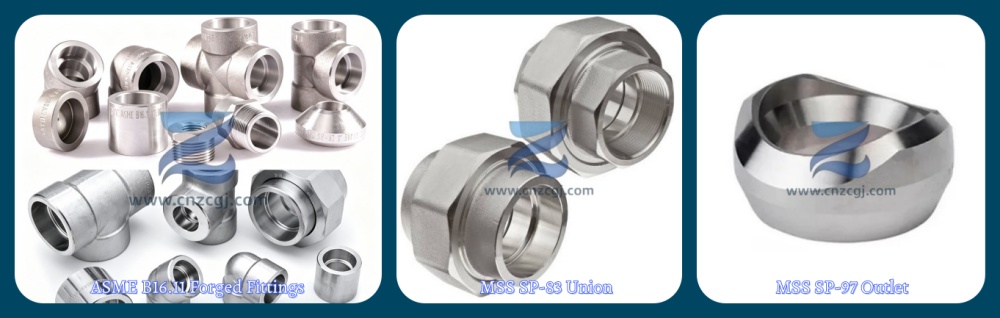
ASME B16.11 – Standard for socket-weld and threaded forged fittings
MSS SP-83 – Specification for forged socket-weld / threaded unions
MSS SP-97 – Specification for forged branch outlets and reinforcing fittings
Full product range: 90° elbows, 45° elbows, tees, cross fittings, caps, couplings, threaded unions, unions, branch outlets – and more.
Size range: NPS 1/8″–4″.
Pressure ratings: Class 2000, 3000, 6000, and 9000.
Fully compatible with high-pressure small-bore process piping, instrument lines, and equipment connection piping.
FPSO topside process lines face high pressure, cyclic loading, and marine salt-spray corrosion. F60 and F53 duplex forged fittings meet thick-wall, complex-structure requirements. Products can pass NORSOK M-650 and ISO 17781 – high-level offshore certifications. Widely used in domestic and international deep-sea floating production projects.
Subsea manifolds and tree equipment operate under high chloride, high pressure, and low-temperature conditions. Ordinary stainless fittings are prone to corrosion failure.
Duplex forged fittings – with dense forged microstructure, no casting defects, and high corrosion resistance – are the preferred material for deep-sea oil & gas projects. They ensure long-term, maintenance-free operation.
Hydrotreating units, chemical reactors, and sour oil/gas transmission lines handle H₂S, CO₂, and chlorides – all of which cause SCC.
F60 and F53 duplex forged fittings are ideal for these acidic, severe services. Excellent high-temperature creep resistance and SCC resistance. Suitable for large-scale, continuous high-pressure petrochemical production.
FGD slurry lines, high-pressure seawater pre-treatment, and brine transfer systems – all handle chloride-containing weak acids.
Duplex forged fittings replace 316L stainless steel – significantly extending equipment service life and reducing maintenance/replacement costs.
We professionally manufacture ASTM A182 F51, F60, and F53 duplex stainless steel forged pipe fittings. Full range of socket-weld and threaded high-pressure fittings.
Manufactured to ASME B16.11 and MSS SP series standards.
Size range: NPS 1/8″–4″. Pressure ratings: Class 2000–9000.
Custom services: non-standard drawings, special wall thickness, and expedited production available.
