


Views: 31 Author: Site Editor Publish Time: 2026-05-15 Origin: Site


In March of this year, we successfully delivered an order of hot dip galvanized BSPT threaded pipe fittings to a regular customer in Australia. The customer purchased these Class 3000 fittings for a local municipal water supply network maintenance project.
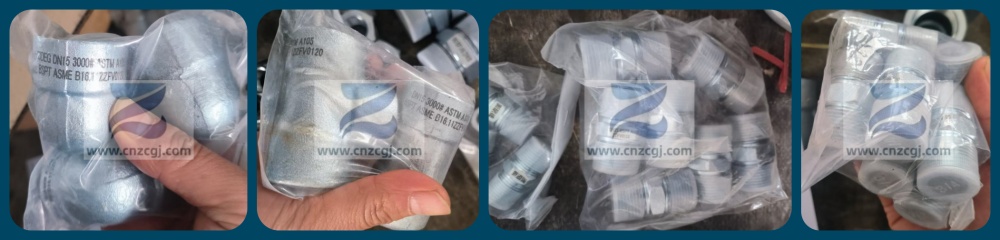
Although the order quantity was small (a regular maintenance project), the delivery was urgent, and the customer requested air freight to Australia. To meet the air freight requirements and help the customer save on shipping costs, we used a simple and light packaging method: each fitting was sealed in a plastic bag, and then packed into a cardboard box. To ensure safety during transport, we reinforced both the inner and outer packaging, filled the box with bubble wrap, and wrapped the outer carton with PE film. The customer received the goods with both the outer packaging and the products completely intact.
Hot dip galvanized threaded fittings play an indispensable role in many industries due to their excellent anti-corrosion performance, high mechanical strength, and simple threaded connection form. BSPT (British Standard Cone Pipe Thread) is mainly used in most parts of the world, such as Europe, Asia (especially China and Japan), Australia, Africa, etc.
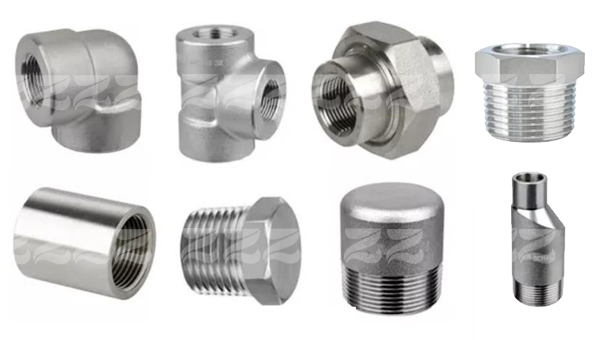
Threaded pipe fittings have threads (male or female) machined onto their inner or outer walls. These threads allow pipes to be connected by screwing them together. Typically manufactured by forging, these fittings are compact, easy to install and disassemble. They offer a clear advantage in situations where on-site welding is dangerous or impossible, or where frequent maintenance is required.
There are many types of threaded pipe fittings to meet the requirements of different industrial pipeline projects. The most common types include:
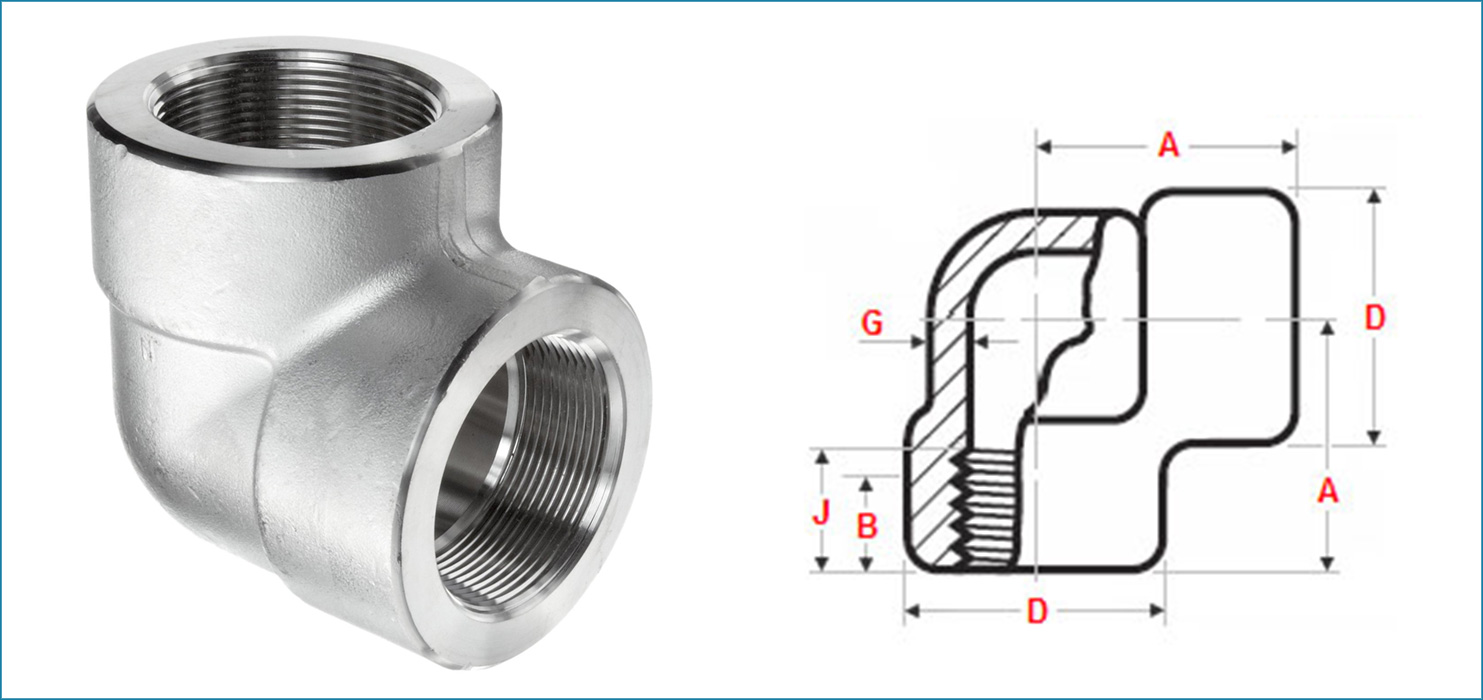
Threaded Elbow (45°/90°): L-shaped, used to change the direction of pipe runs. Available in 45° and 90° versions.
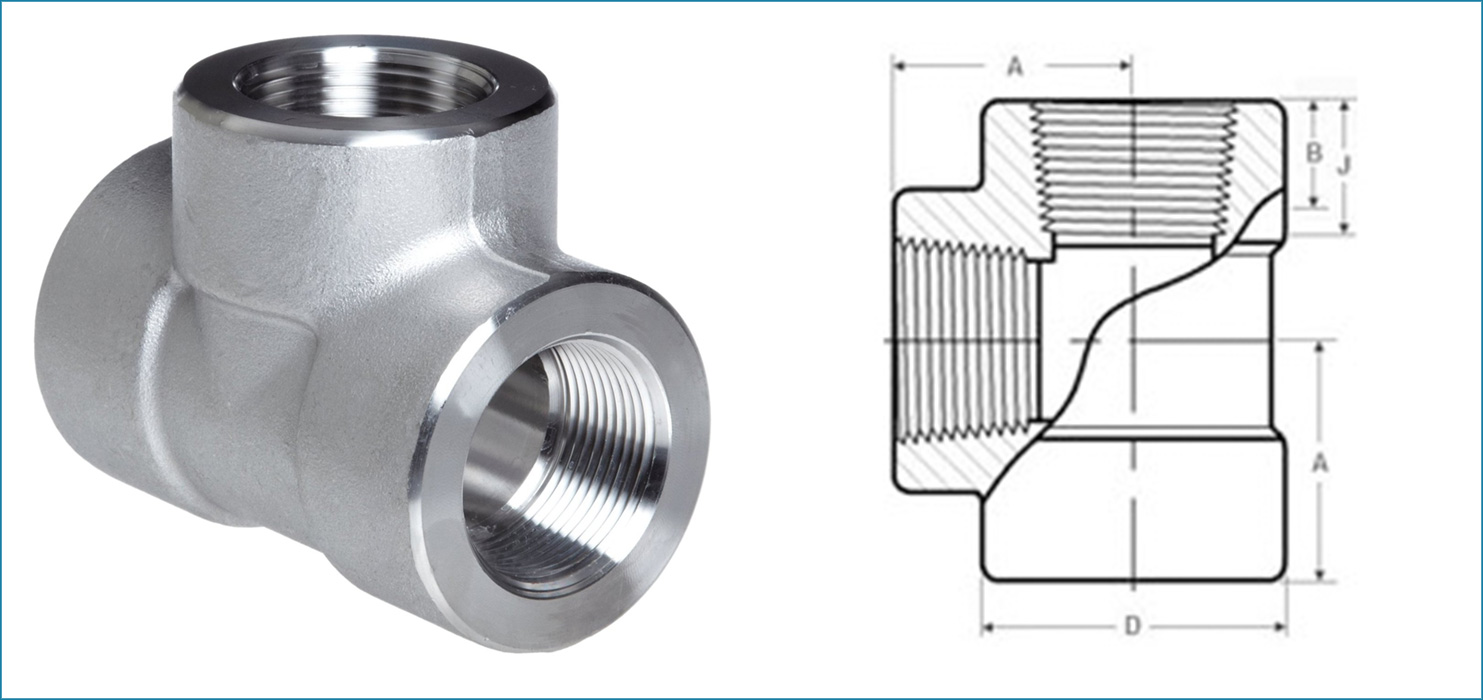
Threaded Tee: T-shaped, used to create a branch from the main pipe, either for splitting flow or combining flow. Available in equal or reducing sizes.

Threaded Coupling: Used to connect two pipes in a straight line. Available as half-coupling or full-coupling.
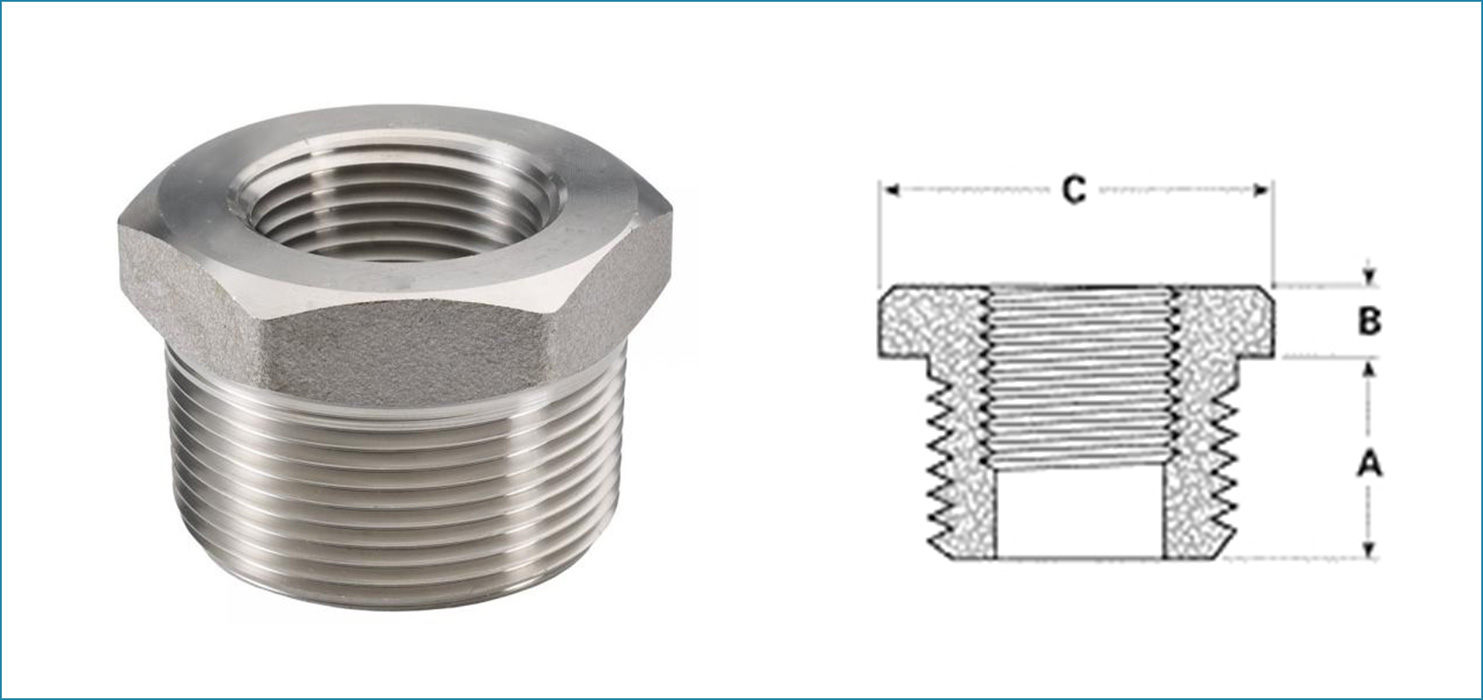
Bushing (Hexagon Bushing): Used to connect pipes of different diameters. A common type has a hexagon body in the middle with male threads on one end and female on the other (available in straight or reducing sizes).
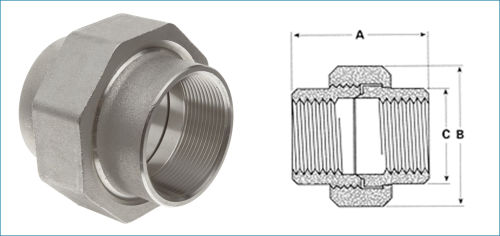
Threaded Union: A three-part fitting (nut, male end, female end) designed for quick and easy disconnection. Ideal for equipment or instrument connections that require regular cleaning or servicing. Pressure ratings are Class 3000 and 6000.
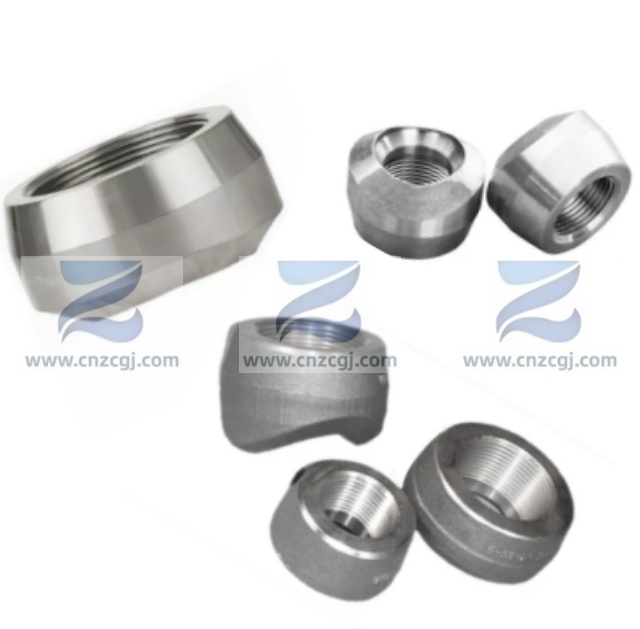
Threadolet: Branch connection fittings manufactured according to MSS SP-97 standard. They are used to connect a branch pipe to a main run pipe, often in high-pressure systems. They can replace traditional tees, reducing the need for welding and extra fittings, which improves installation efficiency.
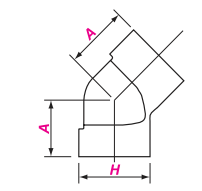
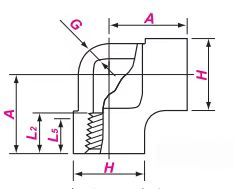
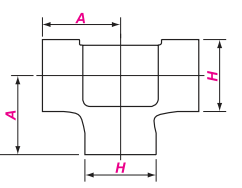
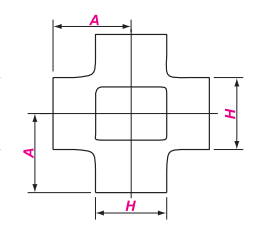
Threaded 45 Elbow | Threaded 45 ° Elbow | Threaded Tee | Threaded Cross | ||||||||||||
GB/T 14383 ASME B16.11 | |||||||||||||||
Nominal Size | Center-to-End | Outside Diameter of Band | Wall Thickness | Length of Thread | |||||||||||
DN | NPS | A | H | G min | L5 min | L2 min | |||||||||
90° Elbows, Tees, Crosses | 45 ° Elbows | ||||||||||||||
2000 | 3000 | 6000 | 2000 | 3000 | 6000 | 2000 | 3000 | 6000 | 2000 | 3000 | 6000 | ||||
6 | 1/8 | 21 | 21 | 25 | 17 | 17 | 19 | 22 | 22 | 25 | 3.18 | 3.18 | 6.35 | 6.4 | 6.7 |
8 | 1/4 | 21 | 25 | 28 | 17 | 19 | 22 | 22 | 25 | 33 | 3.18 | 3.30 | 6.60 | 8.1 | 10.2 |
10 | 3/8 | 25 | 28 | 33 | 19 | 22 | 25 | 25 | 33 | 38 | 3.18 | 3.51 | 6.98 | 9.1 | 10.4 |
15 | 1/2 | 28 | 33 | 38 | 22 | 25 | 28 | 33 | 38 | 46 | 3.18 | 4.09 | 8.15 | 10.9 | 13.6 |
20 | 3/4 | 33 | 38 | 44 | 25 | 28 | 33 | 38 | 46 | 56 | 3.18 | 4.32 | 8.53 | 12.7 | 13.9 |
25 | 1 | 38 | 44 | 51 | 28 | 33 | 35 | 46 | 56 | 62 | 3.68 | 4.98 | 9.93 | 14.7 | 17.3 |
32 | 1 1/4 | 44 | 51 | 60 | 33 | 35 | 43 | 56 | 62 | 75 | 3.89 | 5.28 | 10.59 | 17.0 | 18.0 |
40 | 1 1/2 | 51 | 60 | 64 | 35 | 43 | 44 | 62 | 75 | 84 | 4.01 | 5.56 | 11.07 | 17.8 | 18.4 |
50 | 2 | 60 | 64 | 53 | 43 | 44 | 52 | 75 | 84 | 102 | 4.27 | 7.14 | 12.09 | 19.0 | 19.2 |
65 | 2 1/2 | 76 | 83 | 95 | 52 | 52 | 64 | 92 | 102 | 121 | 5.61 | 7.65 | 15.29 | 23.6 | 28.9 |
80 | 3 | 86 | 95 | 106 | 64 | 64 | 79 | 109 | 121 | 146 | 5.99 | 8.84 | 16.64 | 25.9 | 30.5 |
100 | 4 | 106 | 114 | 114 | 79 | 79 | 79 | 146 | 152 | 152 | 6.55 | 11.18 | 18.67 | 27.7 | 33 |
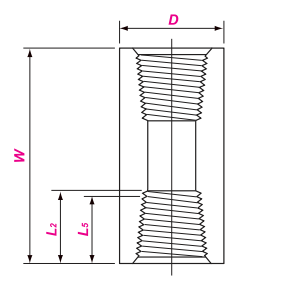
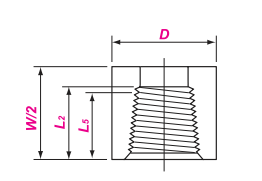
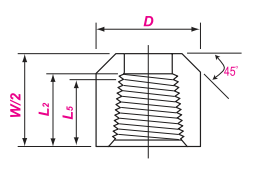
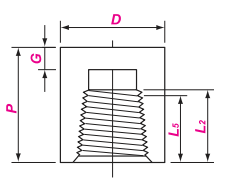
Coupling | Half-Coupling | Boss | Cap | |||||||
Nominal Size | End-to-End | End-to-End | Outside Diameter | End Wall | Length of Thread | |||||
DN | NPS | W | P | D | G min | L5 min | L2 min | |||
3000 & 6000 | 3000 | 6000 | 3000 | 6000 | 3000 | 6000 | ||||
6 | 1/8 | 32 | 19 | 16 | 22 | 4.8 | 6.4 | 6.7 | ||
8 | 1/4 | 35 | 25 | 27 | 19 | 25 | 4.8 | 6.4 | 8.1 | 10.2 |
10 | 3/8 | 38 | 25 | 27 | 22 | 32 | 4.8 | 6.4 | 9.1 | 10.4 |
15 | 1/2 | 48 | 32 | 33 | 28 | 38 | 6.4 | 7.9 | 10.9 | 13.6 |
20 | 3/4 | 51 | 37 | 38 | 35 | 44 | 6.4 | 7.9 | 12.7 | 13.9 |
25 | 1 | 60 | 41 | 43 | 44 | 57 | 9.7 | 11.2 | 14.7 | 17.3 |
32 | 1 1/4 | 67 | 44 | 46 | 57 | 64 | 9.7 | 11.2 | 17.0 | 18.0 |
40 | 1 1/2 | 79 | 44 | 48 | 64 | 76 | 11.2 | 12.7 | 17.8 | 18.4 |
50 | 2 | 86 | 48 | 51 | 76 | 92 | 12.7 | 15.7 | 19.0 | 19.2 |
65 | 2 1/2 | 92 | 60 | 64 | 92 | 108 | 15.7 | 19.0 | 23.6 | 28.9 |
80 | 3 | 108 | 65 | 68 | 108 | 127 | 19.0 | 22.4 | 25.9 | 30.5 |
100 | 4 | 121 | 68 | 75 | 140 | 159 | 22.4 | 28.4 | 27.7 | 33.0 |
Nominal Size | Elbows,Tees & Crosses | Couplings | Half- couplings | |
Center-to-End | End-to-End | End-to-End | ||
DN | NPS | A J | W | W/ 2 |
6~8 | 1/8~1/4 | ± 1.0 | ± 1.0 | ± 1.0 |
10~20 | 3/8~3/4 | ± 1.5 | ± 1.5 | ± 1.5 |
25~50 | 1~2 | ± 2.0 | ± 2.0 | ± 2.0 |
65~100 | 21/2~4 | ± 2.5 | ± 2.5 | ± 2.5 |
Wall thickness correlates with pressure rating and the schedule of the connected pipe.
Joint Type | Class | Grade of Connecting Pipes |
| 2000 | Sch80/XS |
3000 | Sch160 | |
6000 | XXS |
To ensure interchangeability and reliability, strict standards have been established worldwide:
Issued by the American Society of Mechanical Engineers (ASME).
Scope: Covers ratings, dimensions, tolerances, marking, and material requirements for forged fittings. Threaded-end fittings are specified for Classes 2000, 3000, and 6000. Socket-welding end fittings cover Classes 3000, 6000, and 9000.
Product Types: Includes elbows (45°/90°), tees, cross, couplings, caps, plugs, bushings, and other common threaded products.
Issued by the Manufacturers Standardization Society (MSS).
Scope & Definition: A Union is a three-piece threaded fitting designed for quick assembly and disassembly. It consists of a female end, a male end, and a nut.
Complementary to ASME B16.11: While ASME B16.11 covers the basic dimensions for unions, MSS SP-83 provides more detailed requirements for the sealing surfaces (ball-and-socket design), gasket requirements, and pressure-temperature ratings. The two standards are often used together.
Pressure Ratings: Unions manufactured to MSS SP-83 are available for Class 3000, Class 6000, and up to Class 9000.
Issued by the Manufacturers Standardization Society (MSS).
Scope & Definition: This standard defines the dimensions, tolerances, testing, and materials for 90° and 45° integrally reinforced forged branch outlet fittings. Connection types include butt-weld, socket-weld, and threaded ends.
Common Types:
Weldolet: Butt-weld end for a full-penetration weld between run and branch pipes.
Sockolet: Socket-weld end (Class 3000/6000) for small branch connections.
Threadolet: Threaded end (NPT) for branch connections that require no welding.
Latrolet: 45° branch connection (butt-weld/socket-weld/threaded).
The hot dip galvanizing process (threads are cut first, then the fitting is dipped in 450°C molten zinc) provides three key benefits:
Excellent Corrosion Resistance: The zinc coating is 70-100µm thick, offering far superior salt spray resistance compared to electroplating. Suitable for municipal water, marine, and chemical environments.
High Strength and Impact Resistance: The zinc-iron alloy layer is metallurgically bonded to the steel, so it won't peel or flake off, even under mechanical stress during transport and installation.
Accurate Thread Fit: By allowing the correct clearance (per GB/T 22029) and using a centrifugal spin process to remove excess zinc, the final threads pass go/no-go gauges, ensuring smooth, jam-free assembly.

It is crucial to note these differences, as these thread types are not interchangeable.
Feature | NPT | BSPT | BSPP |
Thread Angle | 60° | 55° | 55° |
Thread Type | Tapered (1:16) | Tapered (1:16) | Parallel (Straight) |
Sealing Method | Thread interference + sealant/tape | Thread interference + sealant/tape | End seal (e.g., O-ring, gasket) |
Primary Region | North America | Europe, Asia, Australia, Africa | Europe, Asia |
Simply put, it means the external thread is made slightly larger than the internal thread. When tightened, the peaks and roots of the threads deform elastically, creating high surface pressure. This pressure seals the spiral leakage path between the threads and creates friction to prevent loosening.
Both NPT and BSPT threads use a tapered design to create this interference fit. As the two tapered threads are screwed together, radial pressure gradually increases – that is the source of the interference. This makes BSPT an excellent choice for high-pressure applications like gas, hydraulics, and firefighting systems.
