


Views: 1 Author: Site Editor Publish Time: 2026-10-19 Origin: Site


UNS S32750 (commercial name 2507) is a widely used grade of super duplex stainless steel. Its microstructure balances roughly 50% ferrite and 50% austenite. This delivers high strength and excellent corrosion resistance. For engineers facing seawater, high chloride, or acidic media, understanding UNS S32750 performance limits is critical. It ensures long-term, safe equipment operation. This guide covers chemical composition, standards, material comparisons, and industrial applications. Use it as a complete 2507 duplex steel selection reference.
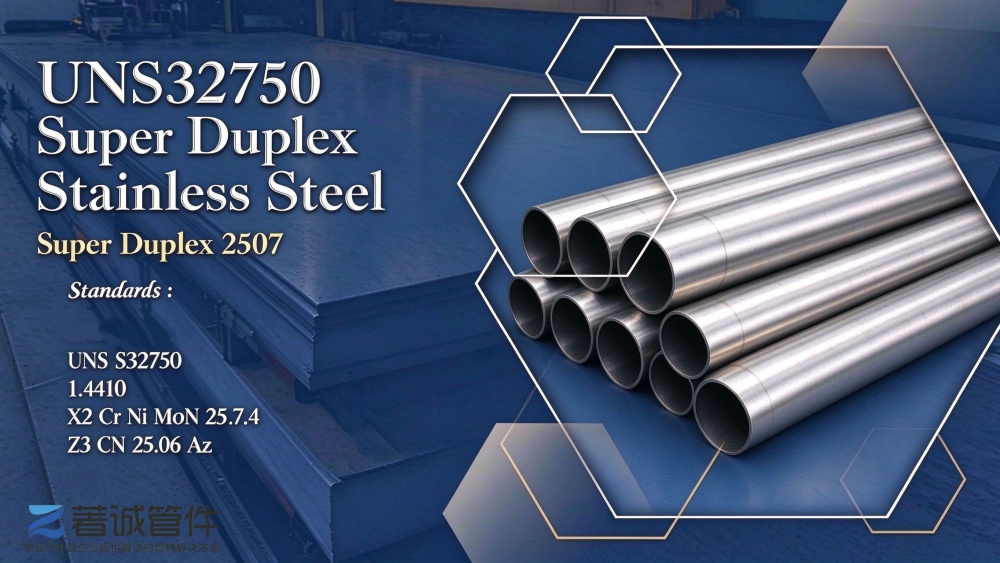
UNS S32750 chemical composition: Cr:24–26% ,Ni:6–8%, Mo:3–5%, N:0.24–0.32% ,PREN ≥ 40, typical 42–43.
UNS S32750 mechanical properties: Yield strength ≥ 550 MPa. Tensile strength ≥ 800 MPa. About 2.5× that of 316L austenitic stainless steel.
UNS S32750 corrosion resistance: Critical pitting temperature (CPT) in 6% FeCl₃ reaches ~65°C. This exceeds 2205 duplex at ~35°C. Outstanding resistance to pitting, crevice corrosion, and chloride stress corrosion cracking.
Long-term service temperature limit: 280°C.
UNS S32750 equivalent material designations vary by standard system and product form. Core principle: the UNS number is globally universal. Product grades change with the standard.
Standard System | Material Designation | Notes |
US UNS | S32750 | Universal base designation |
ASTM A182 | F53 | Forged/flange grade |
Commercial name | 2507 | Non-standard generic name |
European EN | 1.4410 / X2CrNiMoN25-7-4 | Number/steel name |
China GB | 022Cr25Ni7Mo4N / S25073 | New grade/number |
Swedish SS | 2328 | Swedish standard |
Seamless and welded pipe: ASTM A789/A790 (UNS S32750)
Butt Weld Fittings: ASTM A815 (UNS S32750)
Flanges and forgings: ASTM A182 (F53 flange)
Plate: ASTM A240
Castings: ASTM A995 (Grade 5A)
Duplex stainless steel divides into four categories by PREN and alloy content. This helps quickly locate the selection range.
Economical duplex: UNS S32304 (2304), molybdenum-free, PREN ~24–25. Replaces 304/316 in mild corrosion environments.
Standard duplex: UNS S32205 (2205), the benchmark grade. 22% Cr, 3% Mo, 0.15% N, PREN ~35. A widely used general-purpose duplex steel.
Super duplex: UNS S32750 (2507), PREN ≥ 40. Includes S32760 (with W and Cu) and S32550 (with Cu). For harsh corrosion environments.
Hyper duplex: PREN up to 45+. For extreme corrosion conditions.
The performance gap between 2507 duplex and austenitic stainless steel is a common selection question.
Metric | UNS S32750 | 316L | SMO254 |
Yield strength (MPa) | ≥550 | ≥170 | ≥400 |
PREN | ≥41–43 | ≈25 | ≈42–43 |
Pitting resistance | Excellent | Poor | Excellent |
Chloride SCC resistance | Excellent | Poor | Excellent |
Relative cost | High | Low | Higher |
vs 316L: UNS S32750 yield strength is over 2.5× that of 316L. 316L faces stress corrosion cracking risk in chloride environments above 60°C. UNS S32750 strongly resists this. In 80% acetic acid with 2000 ppm chloride at 90°C, 2507 corrosion rate stays below 0.5 mm/year.
vs SMO254: Both have comparable PREN and similar crevice corrosion resistance. SMO254 yield strength is ~400 MPa. UNS S32750 reaches ≥550 MPa. UNS S32750 contains ~7% Ni vs ~18% in SMO254. So 2507 is usually more cost-effective. In pressure design, 2507's high strength allows 20–30% wall thickness reduction. Overall cost advantage is clearer.
Metric | 2205 (S32205) | S32750 | S32760 |
Category | Standard duplex | Super duplex | Super duplex |
PREN (typical) | 34–36 | 42–43 | 41–43 |
Yield strength (MPa) | ≥450 | ≥550 | ≥550 |
CPT (6% FeCl₃) | ~35°C | ~65°C | Comparable |
Relative cost | Baseline | +30–50% | Comparable |
Special elements | — | — | Cu + W |
S32750 vs 2205: UNS S32750 PREN is ~7–8 points higher than 2205. CPT is ~30°C higher. Under crevice conditions, 2205 is unsuitable in 40°C seawater, while 2507 still performs. 2507 yield strength is ~22% higher than 2205. This allows wall thickness reduction at equal pressure.
vs UNS S32760: Both are super duplex. Yield strength is identical. PREN is comparable. S32760 adds 0.5–1.0% Cu and 0.5–1.0% W. Copper improves resistance in reducing acids such as sulfuric and phosphoric acid. Tungsten enhances crevice corrosion resistance. In most routine chloride environments, the two are interchangeable. Selection depends on the specific medium.
UNS S32750 is available as seamless pipe, welded pipe, fittings, flanges, forgings, and bar. Corresponding standards include ASTM A789/A790, A815, A182 (F53), and A240.
Marine engineering & oil and gas: Offshore platform seawater systems, subsea umbilicals, high-pressure water injection lines, manifolds, and separators.
Chemical & petrochemical: Heat exchangers, reactors, flue gas desulfurization (FGD) systems, chemical tanker piping.
Seawater desalination: High-pressure reverse osmosis seawater piping and pump components.
Shipbuilding & paper: Ship overboard discharge pipes, corrosive chemical equipment in pulp and paper mills.
Long-term service temperature should not exceed 280°C. Short-term up to 300°C. Beyond this, sigma phase embrittlement risk exists.
In H₂S-containing sour environments, corrosion resistance exceeds 22Cr duplex. Follow ISO 15156/NACE MR 0103 limits.
Welding requires controlled heat input (typically 0.5–2.5 kJ/mm). Interpass temperature must not exceed 150°C. Use matching filler metals to maintain phase balance.
A: Yes. 2507 is the commercial generic name for UNS S32750. Both refer to the same material. In formal technical documents, use UNS S32750 or EN 1.4410.
A: In most high-chloride or high-strength applications, yes, with wall thickness reduction. But evaluate the specific medium, temperature, and budget. 316L remains economical in mild environments.
A: F53 is the ASTM A182 grade for forged and flanged product forms. Its chemical composition matches UNS S32750. "ASTM A182 F53" is common when purchasing flanges.
A: Long-term service is recommended below 280°C. Short-term up to 300°C. Beyond this, sigma phase precipitation causes embrittlement risk.
A: 2205 suits moderate chloride concentration and temperature environments at lower cost. For high-temperature seawater, high chloride concentration, or higher strength with reduced wall thickness, UNS S32750 is the better choice.
