


Views: 5 Author: Site Editor Publish Time: 2026-10-30 Origin: Site


Recently, our workshop delivered a batch of custom heavy-wall pipe bends. The specifications were DN250 (Φ273x16), material 1.4301//SS304, with both 90-degree and 45-degree configurations. The ends required BE (Bevel End). In petrochemical, marine, and large fluid transmission projects, these SS304 seamless bends are critical components. Any deviation can cause severe on-site welding issues.

DN250 (Φ273x16): This is a typical large-diameter, heavy-wall specification. A 16mm wall thickness indicates high-pressure or high-flow service. Thicker walls significantly increase forming difficulty.
90° & 45° Bend: Note the term "Bend," not "Elbow." Bends typically feature larger radii (e.g., 3D, 5D). They provide smoother fluid transition and lower pressure drop. 45° is for gradual turns; 90° is for rigid directional changes. Always specify the bending radius (R) prior to production.
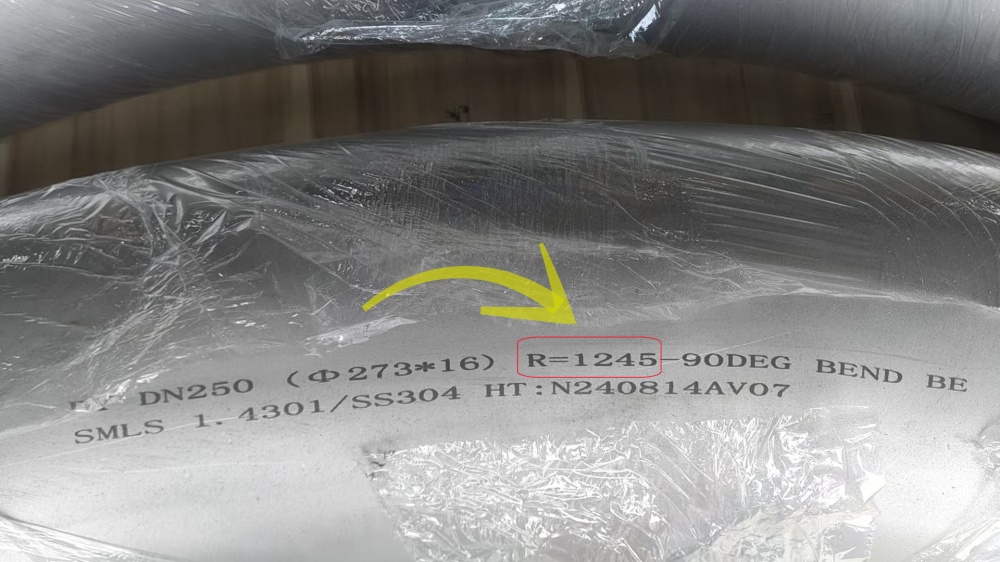
BE Seamless: BE stands for Bevel End. A 16mm heavy wall requires a bevel for full penetration welding. Seamless means the pipe is directly formed without circumferential welds. This ensures high pressure resistance and facilitates pigging operations.
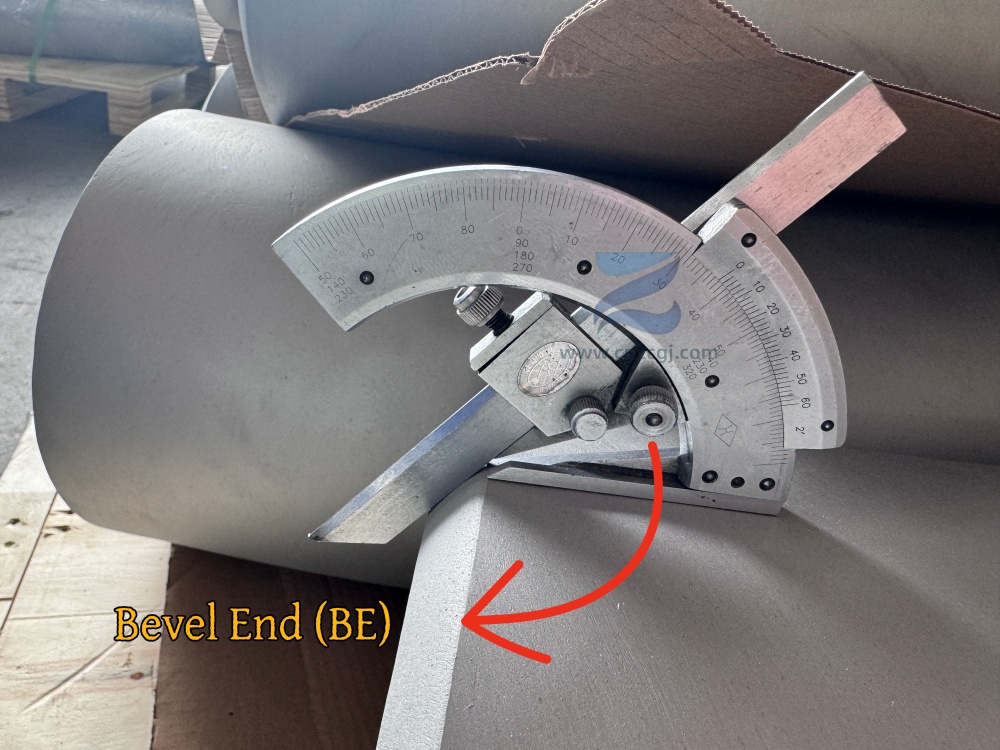
1.4301 /SS304:1.4301 is the EN standard equivalent to ASTM SS304 (GB 06Cr19Ni10). Confirm solution annealing if the bends undergo welding during installation.
Cost-Effective Performance: SS304 contains 18%-20% Chromium and 8%-11% Nickel. It forms a passive film in oxidizing media, offering sufficient resistance to atmospheric and fresh water corrosion.
Mechanical Strength: Yield strength (≥205 MPa) and tensile strength (≥515 MPa) withstand internal stresses in large-diameter systems.
Formability: SS304 offers excellent cold or hot bending performance for 16mm heavy-wall pipes. It also ensures smooth on-site welding.
When to Upgrade: For high-salinity environments (e.g., seawater) or strict intergranular corrosion requirements, upgrade to 316L.
Bending a Φ273x16 heavy-wall pipe involves complex stress distribution. Three critical indicators must be strictly controlled during production and inspection:
Parameter Category | Order Specification | Engineering Significance |
Dimension | DN250, Φ273x16 | Large diameter, heavy wall for high pressure/flow |
Angle Type | 90° & 45° | Directional change; 45° for low pressure drop, 90° for right angles |
Connection | BE (Bevel End) | Designed for full penetration welding of 16mm walls |
Manufacturing | Seamless | No circumferential welds; reduces leak risk, enables pigging |
Material Grade | 1.4301/SS304 | EN/ASTM equivalent; austenitic stainless steel, high cost-effectiveness |
The outer arc experiences tensile stress during bending, causing wall thinning. Industry practice requires the minimum measured wall thickness to be ≥87.5% of the nominal thickness. For a 16mm wall, the thinnest point must not fall below 14mm. This demands precise control of molds and heating temperatures during hot bending.
Large-diameter pipes tend to flatten during bending. High-quality manufacturing strictly controls ovality within 8%. Excessive ovality affects fluid dynamics and causes on-site welding misalignment.
Cold bending causes severe work hardening. Post-forming stress relief or solution annealing is mandatory. This restores corrosion resistance and mechanical properties, preventing stress corrosion cracking (SCC).
ASTM A312: Standard for seamless austenitic stainless steel pipes (base material).
ASTM A403: Standard for wrought austenitic stainless steel fittings (reference for fitting quality).
GB/T 12459: General Chinese standard for steel butt-welding fittings (dimensions, tolerances, inspection).
ASME BPE: Mandatory for pharmaceutical or food-grade applications (strict surface roughness requirements).
A: No material difference. 1.4301 is the EN 10088 designation; SS304 is the ASTM UNS S30400 designation. Their chemical composition and mechanical properties are identical.
A: The angle alone is insufficient; the bending radius (R) must be specified. Is it R=1.5D, 3D, or 5D? If not marked on the drawing, we default to 1.5D (long radius) for quotation and production. Larger radii require different molds and advance communication.
A: For a 16mm wall thickness, direct butt welding on a square end prevents the welding torch from reaching the root. This results in insufficient penetration and potential root leaks under high pressure. We machine bevels at 30°±2.5° to ensure full penetration welding on-site.
