


Views: 1 Author: Site Editor Publish Time: 2026-03-06 Origin: Site


ASME B16.5 flanges play a vital role in industrial piping systems. Their safety and reliability largely depend on the correct selection and installation of fasteners. The dimensional accuracy, pressure class, and material requirements for ASME B16.5 flange fasteners are strictly regulated. These standards cover flanges from Class 150 to 2500 and sizes from DN15 to DN600.
Choosing the right fastener not only ensures sealing performance but also prevents safety risks under high-pressure and high-temperature conditions. This article introduces the connection principles, fastener types, and key selection points for ASME B16.5 flanges and fasteners, helping engineers achieve efficient and reliable flange sealing connections.

The core principle of an ASME B16.5 flange connection is "fastener pre-tension + sealing element sealing." By tightening bolts, the two flange faces are pressed together, deforming the gasket between them to achieve a seal and prevent media leakage.
The flange connection process must be performed strictly according to specifications, including aligning flange bolt holes, selecting the appropriate gasket, and tightening bolts evenly to ensure uniform pressure on the sealing surface and prevent leaks.
Align the matching flanges, ensuring the sealing surfaces are undamaged and clean.
Select a suitable gasket based on design requirements (spiral wound gaskets are common for Raised Face flanges).
Tighten bolts evenly to ensure balanced force on the flange faces.
Although connection details vary for different flange types (socket weld, threaded), the core function of fasteners remains to provide stable pre-tension.
According to the ASME B16.5 standard and industrial applications, common fasteners fall into three main categories:
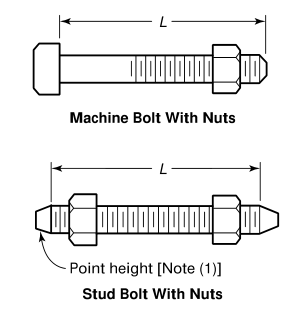
Hex Bolts: Usually used with hex nuts, suitable for general pressure applications.
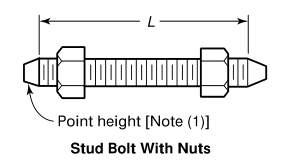
Stud Bolts: Threaded at both ends, used with two nuts. They are the preferred choice for high-pressure and high-temperature conditions.
Fully Threaded Studs: Suitable for applications requiring higher pre-tension and uniform load distribution.
Matching Nuts: Heavy hex nuts are typically used, with materials matching the bolts.
The standard specifies that bolt diameter, number of bolt holes, and other parameters must be adjusted according to the flange Class. For example, a 1-inch Class 150 flange uses 1/2-inch bolts (4 pieces), while a 1-inch Class 300 flange requires 3/4-inch bolts.
| Nomina Pipe Size NPS | Diameter of Bolts IN. | Number of Bolts | Length of Bolts L | ||
| Stud Bolts | Hex Bolts | ||||
| (RF) | (RTJ) | (RF) | |||
| 1/2 | 1/2 | 4 | 55 | - | 50 |
| 3/4 | 1/2 | 4 | 65 | - | 50 |
| 1 | 1/2 | 4 | 65 | 75 | 55 |
| 11/4 | 1/2 | 4 | 70 | 85 | 55 |
| 11/2 | 1/2 | 4 | 70 | 85 | 65 |
| 2 | 5/8 | 4 | 85 | 95 | 70 |
| 21/2 | 5/8 | 4 | 90 | 100 | 75 |
| 3 | 5/8 | 4 | 90 | 100 | 75 |
| 31/2 | 5/8 | 8 | 90 | 100 | 75 |
| 4 | 5/8 | 8 | 90 | 100 | 75 |
| 5 | 3/4 | 8 | 95 | 110 | 85 |
| 6 | 3/4 | 8 | 100 | 115 | 85 |
| 8 | 3/4 | 8 | 110 | 120 | 90 |
| 10 | 7/8 | 12 | 115 | 125 | 100 |
| 12 | 7/8 | 12 | 120 | 135 | 100 |
| 14 | 1 | 12 | 135 | 145 | 115 |
| 16 | 1 | 16 | 135 | 145 | 115 |
| 18 | 1-1/8 | 16 | 145 | 160 | 125 |
| 20 | 1-1/8 | 20 | 160 | 170 | 140 |
| 22 | 1-1/4 | 20 | 170 | 185 | 150 |
| 24 | 1-1/4 | 20 | 170 | 185 | 150 |
| Nomina Pipe Size NPS | Diameter of Bolts IN. | Number of Bolts | Length of Bolts L | ||
| Stud Bolts | Hex Bolts | ||||
| (RF) | (RTJ) | (RF) | |||
| 1/2 | 1/2 | 4 | 65 | 75 | 5 |
| 3/4 | 5/8 | 4 | 75 | 90 | 65 |
| 1 | 5/8 | 4 | 75 | 90 | 65 |
| 11/4 | 5/8 | 4 | 85 | 95 | 70 |
| 11/2 | 3/4 | 4 | 90 | 100 | 75 |
| 2 | 5/8 | 8 | 90 | 100 | 75 |
| 21/2 | 3/4 | 8 | 100 | 115 | 85 |
| 3 | 3/4 | 8 | 110 | 120 | 90 |
| 31/2 | 3/4 | 8 | 110 | 125 | 95 |
| 4 | 3/4 | 8 | 115 | 125 | 95 |
| 5 | 3/4 | 8 | 120 | 135 | 110 |
| 6 | 3/4 | 12 | 120 | 140 | 110 |
| 8 | 7/8 | 12 | 140 | 150 | 120 |
| 10 | 1 | 16 | 160 | 170 | 140 |
| 12 | 1-1/8 | 16 | 170 | 185 | 145 |
| 14 | 1-1/8 | 20 | 180 | 190 | 160 |
| 16 | 1-1/4 | 20 | 190 | 205 | 165 |
| 18 | 1-1/4 | 24 | 195 | 210 | 170 |
| 20 | 1-1/4 | 24 | 205 | 220 | 185 |
| 22 | 1-1/2 | 24 | 230 | 255 | 205 |
| 24 | 1-1/2 | 24 | 230 | 255 | 205 |
| Nomina Pipe Size NPS | Diameter of Bolts IN. | Number of Bolts | Length of Bolts L | ||
| (RF) | (MFM) (T-G) | (RTJ) | |||
| 1/2 | 1/2 | 4 | 75 | 70 | 75 |
| 3/4 | 5/8 | 4 | 90 | 85 | 90 |
| 1 | 5/8 | 4 | 90 | 85 | 90 |
| 11/4 | 5/8 | 4 | 95 | 90 | 95 |
| 11/2 | 3/4 | 4 | 110 | 100 | 110 |
| 2 | 5/8 | 8 | 110 | 100 | 110 |
| 21/2 | 3/4 | 8 | 120 | 115 | 120 |
| 3 | 3/4 | 8 | 125 | 120 | 125 |
| 31/2 | 7/8 | 8 | 140 | 135 | 140 |
| 4 | 7/8 | 8 | 145 | 140 | 145 |
| 5 | 1 | 8 | 165 | 160 | 165 |
| 6 | 1 | 12 | 170 | 165 | 170 |
| 8 | 1-1/8 | 12 | 190 | 185 | 195 |
| 10 | 1-1/4 | 16 | 215 | 210 | 215 |
| 12 | 1-1/4 | 20 | 220 | 215 | 220 |
| 14 | 1-3/8 | 20 | 235 | 230 | 235 |
| 16 | 1-1/2 | 20 | 255 | 250 | 255 |
| 18 | 1-5/8 | 20 | 275 | 265 | 275 |
| 20 | 1-5/8 | 24 | 285 | 280 | 290 |
| 22 | 1-3/4 | 24 | 305 | - | 310 |
| 24 | 1-7/8 | 24 | 330 | 325 | 335 |
| Nomina Pipe Size NPS | Diameter of Bolts IN. | Number of Bolts | Length of Bolts L | ||
| (RF) | (MFM) (T-G) | (RTJ) | |||
| 1/2 | 3/4 | 4 | 110 | 100 | 110 |
| 3/4 | 3/4 | 4 | 115 | 110 | 115 |
| 1 | 7/8 | 4 | 125 | 120 | 125 |
| 11/4 | 7/8 | 4 | 125 | 120 | 125 |
| 11/2 | 1 | 4 | 140 | 135 | 140 |
| 2 | 7/8 | 8 | 145 | 140 | 145 |
| 21/2 | 1 | 8 | 160 | 150 | 160 |
| 3 | 1-1/8 | 8 | 180 | 170 | 180 |
| 4 | 1-1/4 | 8 | 195 | 190 | 195 |
| 5 | 1-1/2 | 8 | 250 | 240 | 250 |
| 6 | 1-3/8 | 12 | 260 | 255 | 265 |
| 8 | 1-5/8 | 12 | 290 | 285 | 300 |
| 10 | 1-7/8 | 12 | 335 | 330 | 345 |
| 12 | 2 | 16 | 375 | 370 | 385 |
| 14 | 2-1/4 | 16 | 405 | 400 | 425 |
| 16 | 2-1/2 | 16 | 445 | 440 | 470 |
| 18 | 2-3/4 | 16 | 495 | 490 | 525 |
| 20 | 3 | 16 | 540 | 535 | 565 |
| 24 | 3-1/2 | 16 | 615 | 610 | 650 |
| Nomina Pipe Size NPS | Diameter of Bolts IN. | Number of Bolts | Length of Bolts L | ||
| (RF) | (MFM) (T-G) | (RTJ) | |||
| 1/2 | 7/8 | 4 | 120 | 115 | 120 |
| 3/4 | 7/8 | 4 | 125 | 120 | 125 |
| 1 | 1 | 4 | 140 | 135 | 140 |
| 11/4 | 1-1/8 | 4 | 150 | 145 | 150 |
| 11/2 | 1-1/4 | 4 | 170 | 165 | 170 |
| 2 | 1-1/8 | 8 | 180 | 170 | 180 |
| 21/2 | 1-1/4 | 8 | 195 | 190 | 205 |
| 3 | 1-3/8 | 8 | 220 | 215 | 230 |
| 4 | 1-5/8 | 8 | 255 | 250 | 260 |
| 5 | 1-7/8 | 8 | 300 | 290 | 310 |
| 6 | 2-1/8 | 8 | 345 | 335 | 355 |
| 8 | 2-1/8 | 12 | 380 | 375 | 395 |
| 10 | 2-5/8 | 12 | 490 | 485 | 510 |
| 12 | 2-7/8 | 12 | 540 | 535 | 560 |
Choosing the right fasteners requires considering the following factors:
Pressure and Temperature Rating: For Class 150, non-toxic, non-flammable media, hex bolts may be suitable. For Class 300 and above, or high-vibration conditions, stud bolts are necessary. For ultra-high pressure Class 1500 and above, fully threaded studs are recommended. High-temperature environments (>500°C) require high-temperature alloy steel bolts.
Media Characteristics: Corrosive environments necessitate corrosion-resistant materials like stainless steel or special alloys.
Dimensional Match: Must comply with standard hole count and diameter per ASME B16.5. Bolt length is determined based on flange thickness and gasket thickness to avoid improper engagement.
Pre-tension Requirement: Calculate required bolt load to avoid under-tightening or over-tightening.
The differences lie in structure, application, installation, and performance:
Structural Difference: Hex bolts have a hexagonal head on one end and a partially or fully threaded shank. Stud bolts are threaded at both ends with no head.
Application: Hex bolts are common in low-pressure, easily disassembled situations. Stud bolts are better for high-pressure, high-temperature, or systems requiring frequent disassembly due to better load distribution and fatigue resistance.
Installation: Stud bolts require two nuts and specialized tools to ensure even tension on both ends.
Performance: Stud bolts offer better connection stability and service life compared to hex bolts but have a slightly higher procurement cost and require nuts for installation.
Material selection directly impacts temperature and corrosion resistance:
Carbon Steel: ASTM A307, A193 B7. Suitable for general conditions.
Alloy Steel: A193 B16, B8M. High strength, high-temperature resistance.
Stainless Steel: A193 B8 (304), B8M (316). Good corrosion resistance.
Special Alloys: Hastelloy, Titanium. For extreme corrosive environments.
Surface treatments enhance corrosion resistance and service life:
Zinc Plating: Economical, provides basic rust protection.
Hot-Dip Galvanizing: Thicker coating, suitable for outdoor use.
Dacromet (Zinc-Chromium Coating): Excellent corrosion resistance, no hydrogen embrittlement risk.
Phosphating: Improves lubricity, often used in assembly.
Black Oxide: Aesthetic and offers some rust resistance.
Sealing reliability depends on the cooperation between fasteners and the sealing system:
Gasket Selection: Choose gaskets based on flange face type. Raised Face (RF) flanges often use spiral wound gaskets. For Ring Type Joint (RTJ) flanges in ultra-high pressure, bolts compress a metal ring gasket for a metal-to-metal seal.
Bolt Pre-tension: Tighten gradually in a cross-pattern sequence. Use torque wrenches or hydraulic tensioners to ensure uniform load.
Regular Inspection: Re-check bolt torque after operation to prevent loosening.
Code Compliance: Strictly follow ASME PCC-1 "Guidelines for Pressure Boundary Bolted Flange Joint Assembly."
Selecting and sizing ASME B16.5 flange fasteners correctly is critical for safe industrial pipeline operation. Matching pressure class, dimensional parameters, and material properties is essential to achieve optimal sealing performance. We provide a full range of ASME B16.5 compliant flange fasteners in various materials like carbon steel, stainless steel, and alloy steel, offering customized dimensional solutions based on specific operating conditions, strictly adhering to standards to ensure reliable connections for piping systems.
