


Views: 14 Author: Site Editor Publish Time: 2025-08-13 Origin: Site


As a core component in industrial pipeline systems, ASTM A182 flanges have become a trusted connection solution for high-temperature and high-pressure industrial environments due to their excellent performance and rigorous standard system.
The ASTM A182 standard, as an authoritative specification developed by the American Society for Testing and Materials, sets strict technical barriers for forged alloy and stainless steel pipeline components. This standard covers the entire process control from material to finished product inspection, clearly defining four core requirements: chemical composition, tolerance range, heat treatment process parameters, mechanical performance indicators, and non-destructive testing requirements.
The ASTM A182 steel flange standard covers various material categories such as alloys, stainless steel, and duplex stainless steel, each optimized for specific industrial piping systems.
F11 (1.25Cr-0.5Mo): a classic representative of chromium molybdenum alloy, with a yield strength of ≥ 205MPa and a tensile strength of ≥ 415MPa. It performs excellently in medium temperature and high pressure environments below 450 ℃ and is commonly used in steam pipeline systems of thermal power plants. Its unique tempering brittleness suppression process enables it to maintain impact toughness of ≥ 27J even under temperature fluctuation conditions.
F22 (2.25Cr-1Mo): By increasing the chromium molybdenum content to enhance oxidation resistance, the upper temperature limit for use is raised to 550 ℃, and the tensile strength reaches over 485MPa. It is an important material for high-temperature gas pipelines in coal chemical plants.
F91 (9Cr-1Mo-V-Nb): a benchmark product of martensitic heat-resistant steel, with a yield strength of ≥ 415MPa and excellent creep resistance. It can maintain structural integrity even after long-term service at 600 ℃ and is widely used in the main steam pipelines of supercritical units.
Chemical Composition
| CHEMICAL | LIMITS | C | Mn | P | S | Si | Ni | Cr | Mo | Cb |
| ASTM A182 F11 CL1 | MIN | 0.05 | 0.30 | 0.50 | 1.00 | 0.44 | ||||
| MAX | 0.15 | 0.60 | 0.03 | 0.03 | 1.00 | 1.50 | 0.65 | |||
| ASTM A182 F11 CL2 | MIN | 0.10 | 0.30 | 0.50 | 1.00 | 0.44 | ||||
| MAX | 0.20 | 0.80 | 0.04 | 0.04 | 1.00 | 1.50 | 0.65 | |||
| ASTM A182 F11 CL3 | MIN | 0.05 | 0.30 | 0.50 | 1.00 | 0.44 | ||||
| MAX | 0.15 | 0.60 | 0.03 | 0.03 | 1.00 | 1.50 | 0.65 | |||
| ASTM A182 F22 CL1,CL3 | MIN | 0.05 | 0.30 | 2.00 | 0.87 | |||||
| MAX | 0.15 | 0.60 | 0.04 | 0.04 | 0.50 | 2.50 | 1.13 | |||
| ASTM A182 F91 | MIN | 0.08 | 0.30 | 0.02 | 8.00 | 0.85 | 0.06 | |||
| MAX | 0.12 | 0.60 | 0.02 | 0.01 | 0.50 | 0.40 | 9.50 | 1.05 | 0.10 |
Material | Yield strength (MPa) | Tensile strength (MPa) | Elongation rate (%) | Advantages | Application |
304(F304) | ≥205 | ≥515 | ≥40 | Corrosion Resistance Cost Optimization | Food Processing |
316(F316) | ≥205 | ≥515 | ≥40 | Containing 2-3% Mo, the anti pitting ability is improved by 30% | Seawater Desalination System |
321(F321) | ≥205 | ≥515 | ≥40 | Titanium stabilization treatment, resistant to intergranular corrosion | High Temperature Heat Exchanger |
Chemical Composition
| CHEMICAL | LIMITS | C | Mn | P | S | Si | Ni | Cr | Mo | N | Ti |
| ASTM A182 F304 | MIN | 8.0 | 18.0 | ||||||||
| MAX | 0.08 | 2.00 | 0.045 | 0.030 | 1.00 | 11.0 | 20.0 | 0.10 | |||
| ASTM A182 F316 | MIN | 10.0 | 16.0 | 2.00 | |||||||
| MAX | 0.08 | 2.00 | 0.045 | 0.030 | 1.00 | 14.0 | 18.0 | 3.00 | 0.10 | ||
| ASTM A182 F321 | MIN | 9.00 | 17.00 | 0.10 | 5(C+N) | ||||||
| MAX | 0.08 | 2.00 | 0.05 | 0.03 | 1.00 | 12.00 | 19.00 | 0.70 |
F51 (2205): A classic ratio of 22% Cr-5% Ni-3% Mo, with a yield strength of up to 450MPa (more than twice that of 304) and a tensile strength of ≥ 620MPa. It also has the toughness of austenite and the corrosion resistance of ferrite, and performs outstandingly in sulfur-containing environments for oil and gas extraction.
F53 (2507): A representative of super duplex steel, with chromium content increased to 25% and molybdenum content up to 4%. Its resistance to chloride ion corrosion is 50% higher than F51, making it suitable for deep-sea oil and gas pipelines and high concentration saltwater treatment systems.
Chemical Composition
| CHEMICAL | LIMITS | C | Mn | P | S | Si | Ni | Cr | Mo | N | Cu |
| ASTM A182 F51 | MIN | 4.50 | 21.00 | 2.50 | 0.08 | ||||||
| MAX | 0.03 | 2.00 | 0.030 | 0.020 | 1.00 | 6.50 | 23.00 | 3.50 | 0.20 | ||
| ASTM A182 F53 | MIN | 6.00 | 24.00 | 3.00 | 0.24 | ||||||
| MAX | 0.03 | 1.20 | 0.035 | 0.020 | 0.80 | 8.00 | 26.00 | 5.00 | 0.32 | 0.5 |
Mechanical Properties
| MATERIAL | ASTM A182 F51 | ASTM A182 F53 |
| T.S (MPA) | 620 min | 800 min |
| Y.S (MPA) | 450 min | 550 min |
| EL % | 25 min | 25 min |
| R/A % | 45 min | 15 min |
| HARDNESS | 310 max |
ASTM A182 steel flanges are mainly divided into six types: Weld Neck Flange, Slip On Flange, Socket Weld Flange, Threaded Flange,Lap Joint Flange, and Blind Flange.
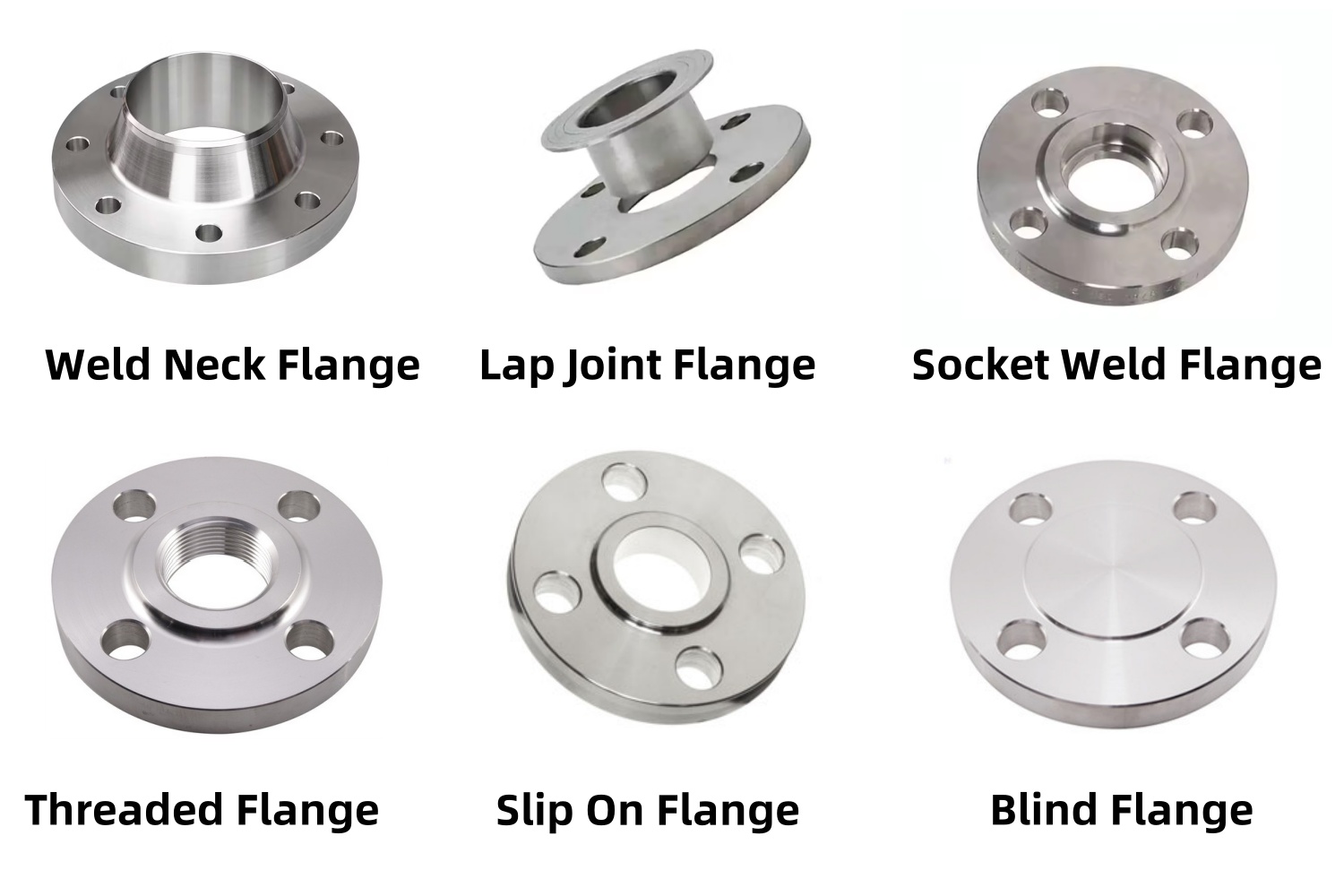
Wled neck flange refers to a flange with a neck and a groove on the outer side of the neck, which is used for butt welding with pipelines or equipment. Its structural feature is that the flange body is welded to a section of conical circular pipe (i.e. the neck), and the height of the neck varies according to different pressure levels and standards. Butt welding flange is an important pipeline connection, commonly used in medium and high pressure and temperature fluctuating pipeline systems. The neck welding structure makes it the core choice for high-pressure systems, and the neck design forms a smooth stress transition zone, which can reduce welding residual stress by more than 40%.
Structural Features:
Neck structure: having a conical neck that extends upwards and gradually becomes thinner
Butt weld: perform circular butt welding between the neck and the pipeline or equipment
Groove design: The neck end is usually processed into a groove to facilitate good fusion during welding and ensure welding quality
Flat welding flange is a special type of ASTM A182 flange, which refers to a type of flange that is welded with circular fillet welds on the inside and outside of the flange by fitting the flange onto the end of the pipeline. Its characteristic is that the inner diameter of the flange is slightly larger than the outer diameter of the pipeline. When installing, the flange is fitted into the pipeline and double-sided fillet welding is required during welding. Flat welding flanges are commonly used in low-pressure and medium pressure pipeline systems with low connection strength requirements. Adopting a lap welding structure for rapid installation, the flange inner diameter is precisely matched with the pipeline outer diameter (with a tolerance control of ± 0.5mm), suitable for medium and low pressure systems of Class 150-300. Its outstanding advantage is a 60% reduction in welding workload, which is widely used in non corrosive environments such as urban water supply and drainage, and ordinary industrial water. The installation cost is 30-40% lower than that of welded flanges.
Structural Features:
Sleeve type connection: The inner diameter of the flange is slightly larger than the outer diameter of the pipeline, and it is directly fitted onto the pipeline during installation
Double sided fillet weld: fixed by welding two circular fillet welds to the pipeline on the inside and outside of the flange
Neck free design: typically without a tapered neck like a butt welded flange
Socket flange is a type of flange that is welded by inserting the end of the pipeline into the socket hole of the flange and then welding it with a circular fillet weld. Its characteristic is that the inner diameter of the flange has a socket hole slightly larger than the outer diameter of the pipeline, and there is a step socket welding method used to locate the depth of pipeline insertion. Socket welding flanges are commonly used in small and medium-sized medium and low-pressure pipeline systems. Specially designed for small-diameter pipelines below DN50, the depth of the socket hole is precisely controlled to be 1.2 times the outer diameter of the pipeline, and it is matched with positioning steps to ensure welding concentricity. The welding area of fillet welds is 25% larger than that of flat welding flanges. They replace threaded connections in Class 300-600 small and medium-sized high-pressure systems, avoiding the risk of thread seal failure. They are commonly used in instrument pipelines and hydraulic systems.
Structural Features:
Socket design: The inner diameter of the flange is machined into a stepped socket, into which the pipeline is inserted and positioned by the step
Fillet weld connection: The connection is achieved by welding a circular fillet weld between the outside of the flange and the pipeline
No groove: Unlike butt welding flanges, the pipe ends of socket welding flanges usually do not require groove treatment
Threaded flange is a type of non welded flange that processes the inner hole of a flange into pipe threads and connects it to a threaded pipe. Its characteristic is that the inner hole of the flange is machined with standard threads, which can be connected by simple tightening without the need for welding. Threaded flange is usually used in low-pressure small-diameter pipeline systems that do not require welding, especially in situations where welding is not allowed or on-site welding is difficult. The precise fit between the internal thread and the external thread of the pipeline achieves a seamless connection, which has irreplaceable advantages in explosion-proof areas where hot work is strictly prohibited, such as gas stations and chemical storage tank areas. When using NPT thread sealing structure, it can achieve zero leakage under Class 150 pressure with PTFE sealing tape, and the installation time is only 1/3 of the welding flange.
Structural Features:
Internal thread design: The flange inner hole is machined with threads that comply with relevant standards
No welding connection: By tightening the external threads on the pipeline or equipment, no welding operation is required
Multiple sealing surface options: You can choose sealing surface forms such as flat (FF), protruding (RF), etc. according to your needs
Blind flange is a unique connection form of ASTM A182 flange, which is actually a flange without a hole in the middle. One of its functions is to block the end of the pipeline, and the other is to facilitate the removal of debris in the pipeline during maintenance, which is the same function as the head and pipe cap. But the head cannot be disassembled, and the flange blind plate is fixed with bolts, which is very convenient for disassembly. It is usually fixed to the flange of the pipeline or equipment by bolts, and a gasket is used between the two to achieve a sealed solid disc structure design that can withstand the pressure of the entire system. The thickness is designed to be 1.5 times that of the flange of the same specification, and it plays a key role in the end sealing of the pipeline and system isolation.
Structural Features:
No central hole: This is the most prominent feature of blind flange
Disk shaped or circular: The shape is usually circular and can also be made into other shapes according to special needs
Bolt holes: Several evenly distributed bolt holes around the perimeter, used for connecting and fixing with other flanges
Lap joint flange is not directly welded to the pipeline, but connected to the pipeline through a flanged short section. The loose flange itself is a circular ring with bolt holes, with an inner diameter slightly larger than the outer diameter of the flanged short section, and can slide freely on the flanged short section.
Structural Features:
Loose ring: The flange itself is a loose ring, with an inner diameter slightly larger than the outer diameter of the connecting piece (usually a flanged short joint)
Flanged short section: a short pipe that has been flanged, with one end welded to the pipeline and the other end forming a sealing surface and a compressed flanged edge
Non welded connection (flange itself): The flange itself is not directly welded to the pipeline
Relying on flanging to achieve sealing: Sealing is achieved by tightening the flanging short section with bolts to achieve sealing
As a matching dimension specification for ASTM A182 steel flange, ASME B16.5 establishes a globally recognized system of pipe connection dimensions:
The size includes the complete range of 1/2" to 24".
Pressure ratings include:
Class 150: suitable for low-pressure systems below 1.6MPa, with flange thickness ranging from 12.7mm (NPS 2) to 22.2mm (NPS 24);
Class 300: withstand pressure of 2.5-6.3 MPa, with a thickness increase of 40-60% compared to Class 150;
Class 600: The main grade of high-voltage systems, with a thickness of 2-3 times that of Class 150, and an increase in the number of bolts to 8-24;
Class 900/1500/2500: Ultra high pressure rating, with special thickening design, suitable for extreme working conditions above 10MPa.
Types | WN Flange、SO Flange、SW Flange、TH Flange、LAPJ Flange、BL Flange |
Sealing Surface | RF、FF 、RTJ |
Dimension | 1/2"- 60" / DN15 - DN1500 |
Standard | ASME B16.5,ASME B16.47 A/B |
Alloy Steel | STM A182 F11 / 12 / 5 / 9 / 91 / 92 |
Stainless Steel | ASTM A182 F304/304L/304H, 316/316L, 310S, 317,347,904L |
Duplex Stainless Steel | ASTM A182 F51, F53, F44 |

Nominal Pipe Size | A | B | C | D | E | F | G | H | I | J | Weight | |
inch | mm | mm | mm | mm | mm | mm | mm | mm | Holes | mm | mm | kg / piece |
1/2 | 21.30 | 88.90 | 15.70 | 11.20 | 47.80 | 21.30 | 30.20 | 35.00 | 4 | 15.70 | 60.45 | 0.48 |
3/4 | 26.70 | 98.60 | 20.80 | 12.70 | 52.30 | 26.70 | 38.10 | 42.90 | 4 | 15.70 | 69.85 | 0.71 |
1 | 33.40 | 108.0 | 26.70 | 14.20 | 55.60 | 33.50 | 49.30 | 50.80 | 4 | 15.70 | 79.25 | 1.01 |
11/4 | 42.20 | 117.3 | 35.10 | 15.70 | 57.15 | 42.20 | 58.70 | 63.50 | 4 | 15.70 | 88.90 | 1.33 |
11/2 | 48.30 | 127.0 | 40.90 | 17.50 | 62.00 | 48.30 | 65.00 | 73.15 | 4 | 15.70 | 98.60 | 1.72 |
2 | 60.30 | 152.4 | 52.60 | 19.10 | 63.50 | 60.45 | 77.70 | 91.90 | 4 | 19.10 | 120.7 | 2.58 |
21/2 | 73.00 | 177.8 | 62.70 | 22.40 | 69.85 | 73. 15 | 90.4 | 104.6 | 4 | 19.10 | 139.7 | 4.11 |
3 | 88.90 | 190.5 | 78.00 | 23.90 | 69.85 | 88.90 | 108.0 | 127.0 | 4 | 19.10 | 152.4 | 4.92 |
31/2 | 101.6 | 215.9 | 90.20 | 23.90 | 71.40 | 101.6 | 122.2 | 139.7 | 8 | 19.10 | 177.8 | 6.08 |
4 | 114.3 | 228.6 | 102.40 | 23.90 | 76.20 | 114.3 | 134.9 | 157.2 | 8 | 19.10 | 190.5 | 6.84 |
5 | 141.3 | 254.0 | 128.3 | 23.90 | 88.90 | 141.2 | 163.6 | 185.7 | 8 | 22.40 | 215.9 | 8.56 |
6 | 168.3 | 279.4 | 154.2 | 25.40 | 88.90 | 168.4 | 192.0 | 215.9 | 8 | 22.40 | 241.3 | 10.6 |
8 | 219.1 | 342.9 | 202.7 | 28.40 | 101.6 | 219.2 | 246.1 | 269.7 | 8 | 22.40 | 298.5 | 17.6 |
10 | 273.0 | 406.4 | 254.5 | 30.20 | 101.6 | 273.0 | 304.8 | 323.8 | 12 | 25.40 | 362.0 | 24.0 |
12 | 323.8 | 482.6 | 304.8 | 31.75 | 114.3 | 323.8 | 365.3 | 381.0 | 12 | 25.40 | 431.8 | 36.5 |
14 | 355.6 | 533.4 | To be specified by | 35.10 | 127.0 | 355.6 | 400.1 | 412.7 | 12 | 28.40 | 476.3 | 48.4 |
16 | 406.4 | 596.9 | 36.60 | 127.0 | 406.4 | 475.2 | 469.9 | 16 | 28.40 | 539.8 | 60.6 | |
18 | 457.2 | 635.0 | 39.60 | 139.7 | 457.2 | 505.0 | 533.4 | 16 | 31.75 | 577.9 | 68.3 | |
20 | 508.0 | 698.5 | 42.90 | 144.5 | 508.0 | 558.8 | 584.2 | 20 | 31.75 | 635.0 | 84.5 | |
24 | 609.6 | 812.8 | 47.80 | 152.4 | 609.6 | 663.4 | 692.1 | 20 | 35.10 | 749.3 | 115 | |
Energy Sector
Chemical Industry
High End Manufacturing Field
Environmental Protection and New Energy
Development of Superalloy Materials
Innovation in Intelligent Manufacturing Process
Integration of Intelligent Monitoring System
Construction of Green Manufacturing System
The development process of ASTM A182 steel flange is a vivid reflection of the progress in industrial materials technology. From the initial carbon steel flange to the current super duplex steel intelligent flange, every technological breakthrough is driving the development of industrial pipeline systems towards safer, more efficient, and more environmentally friendly directions. At a critical period of global industrial upgrading and energy transformation, ASTM A182 steel flange is providing solid support for building a sustainable industrial future with their continuous innovation capabilities, becoming a key link between the present and the future.
