


Views: 13 Author: Site Editor Publish Time: 2025-11-26 Origin: Site


Forged socket fittings refer to fittings with socket and insertion structures formed by forging high-quality steel, and connected to pipelines through socket welding.
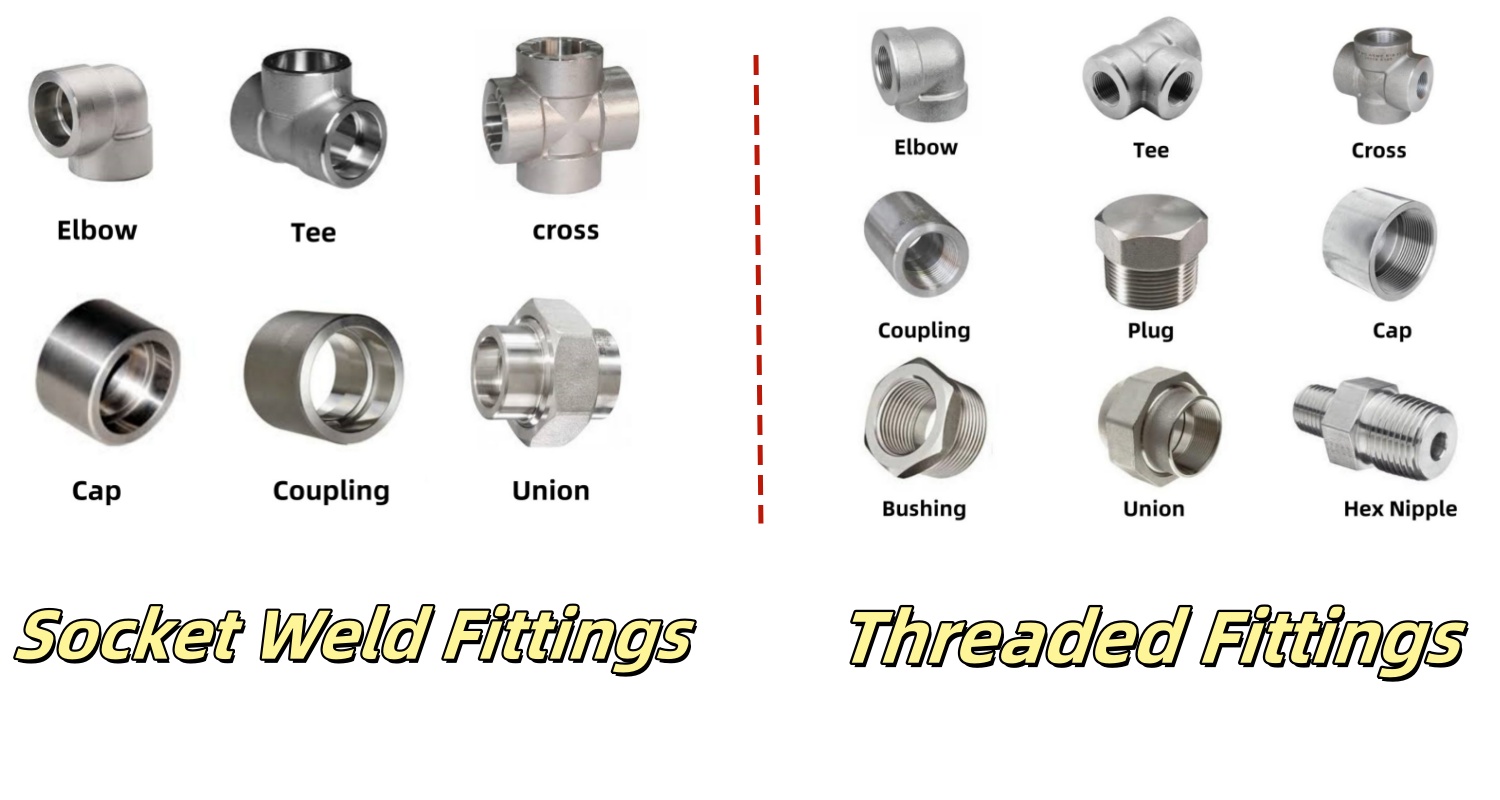
Forged pipe fittings refer to pipe fittings made by forging forming process, usually used in industrial pipeline systems that need to withstand high temperature and high pressure environments. According to ASME B16.11 standard, forged fittings can be divided into two categories: socket fittings (SW fittings) and threaded fittings (TH fittings).
Size | 1/8"- 4"/ DN6 - DN100 |
Pressurer | 3000lbs, 6000lbs,9000lbs |
Standard | ASME B16.11, BS3799,GB/T 14383 |
Carbon Steel | ASTM A105/A105N |
Stainless Steel | ASTM A182 F304/304L/304H、F316/316L、F317、F310S、F321、F347、F904L |
Alloy Steel | ASTM A182 F5 / F9 / F11 / F12 / F22 / F91 / F92 |
There are various types of socket fittings, including socket elbows, tees, tees, pipe caps, pipe clamps, branch sockets, and flexible joints.
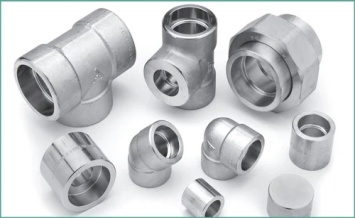
Socket Elbow: a pipe turning connector manufactured using precision forging technology. The product is divided into three specifications according to the turning angle: 45 deg, 90 deg, and 180 deg.
SW Tee/Cross: a key component for pipeline diversion, divided into equal diameter three-way/four-way and reducing three-way/four-way, with the main and branch pipes inserted into corresponding sockets.
Cap (SW): It is a pipe terminal seal with a double-layer sealing groove at the end. The pipe end is inserted into the pipe cap socket for connection.
SW Coupling: A short pipe used to connect two pipes, with the two pipes inserted into the ends of the coupling for connection.
SW Union: It is a commonly used pipeline connector that can be easily installed and disassembled. First, weld the female and male ends to two sections of the pipeline, align them, and then insert the locking ring and tighten it.
Socktolet: mainly used for reinforcing pipe fittings for branch connections, strengthening branch connections such as pipe sections.
Size | 1/8"- 4"/ DN6 - DN100 |
Pressure | 2000lbs, 3000lbs, 6000lbs |
Standard | ASME B16.11, BS3799,GB/T 14383 |
Carbon Steel | ASTM A105/A105N |
Stainless Steel | ASTM A182 F304/304L/304H、F316/316L、F317、F310S、F321、F347、F904L |
Alloy Steel | ASTM A182 F5 / F9 / F11 / F12 / F22 / F91 / F92 |
Threaded fittings are fittings that connect pipes through threaded connections, including threaded elbows, tees, tees, pipe caps, pipe clamps, branch sockets, flexible joints, short joints, reducing short joints, hexagonal short joints, pipe plugs, and repair cores. The following is a detailed introduction to them.
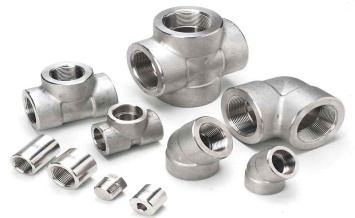
Threaded Elbow: Used to change the direction of a pipeline, use pipe pliers to tighten the elbow onto the pipeline thread for connection, usually at standard angles such as 45 °, 90 °, 180 °, etc.
TH Tee: A standard connector for pipeline diversion, with all interfaces machined with tapered pipe threads.
Threaded Cap: a sealing protective component at the end of the pipeline, designed with tapered threads to ensure sealing.
Threaded Coupling: a standard component for direct connection of pipelines, with internal threads machined on both ends.
Bushing: It is a variable diameter transition piece used in pipeline systems through internal and external threads.
MSS SP-83 Threaded Union: It is a commonly used pipeline connector that can be easily installed and disassembled by screwing both ends into the pipeline to be connected.
MSS SP-97 Threaded Outlet: mainly used for reinforcing pipe fittings for branch pipe connections, achieved by screwing with corresponding threaded pipe fittings.
Swage Nipple: a short section with different diameters at both ends, used to connect pipes or fittings of different diameters.
Hex Nipple: a short section with a hexagonal structure in the middle, which is easy to install or remove with a wrench.
The installation and use of forged socket fittings is a rigorous process, with the core being "socket welding". The following are the standard usage methods and steps:
Material Inspection
Pipeline pretreatment
Group pairing and point fixation
Welding material selection
welding operation
weld inspection
For materials with specific requirements, post weld heat treatment (PWHT) may be necessary to eliminate welding residual stresses and improve the metal structure in the weld area.
After the installation of the entire pipeline system, a pressure test (water pressure test or air pressure test) must be conducted to verify the sealing and strength of all socket welding joints and other connection points under the design pressure.
The reason why forged socket fittings are irreplaceable in specific fields is due to a series of outstanding advantages:
Extremely high connection strength and reliability
Excellent sealing performance
Compact structure, space saving
Good fatigue and vibration resistance performance
Long service life and low maintenance cost
Smooth inner wall, low fluid resistance
Despite significant advantages, forged socket fittings also have some inherent limitations that need to be carefully considered in design and selection:
The installation process is complex and the technical requirements are high
Non removable
Welding residual stress and heat affected zone
High installation and positioning accuracy requirements
The initial investment is relatively high
Not suitable for specific materials
Forged socket fittings are a pipeline connection solution designed for high reliability, high pressure, high temperature, and harsh environments. Its outstanding strength, perfect sealing, and compact structure are its core advantages, making it play an irreplaceable role in situations that require safety and no leakage. However, its non removable nature, complex installation process, and high technical requirements also limit its application scope.
Therefore, in engineering practice, choosing whether to use forged socket fittings is a comprehensive balancing process. Designers need to make decisions between the reliability, safety, space constraints, installation/maintenance convenience, and cost-effectiveness of the system. In those main process pipelines where the consequences of leakage are unimaginable and the system structure is relatively stable without frequent changes, forged socket fittings are undoubtedly the best choice.
